Buyer Knowledge Center

Glass Buyer Knowledge Hub

Practical comparisons and specification notes for coated glass sourcing.

Product families

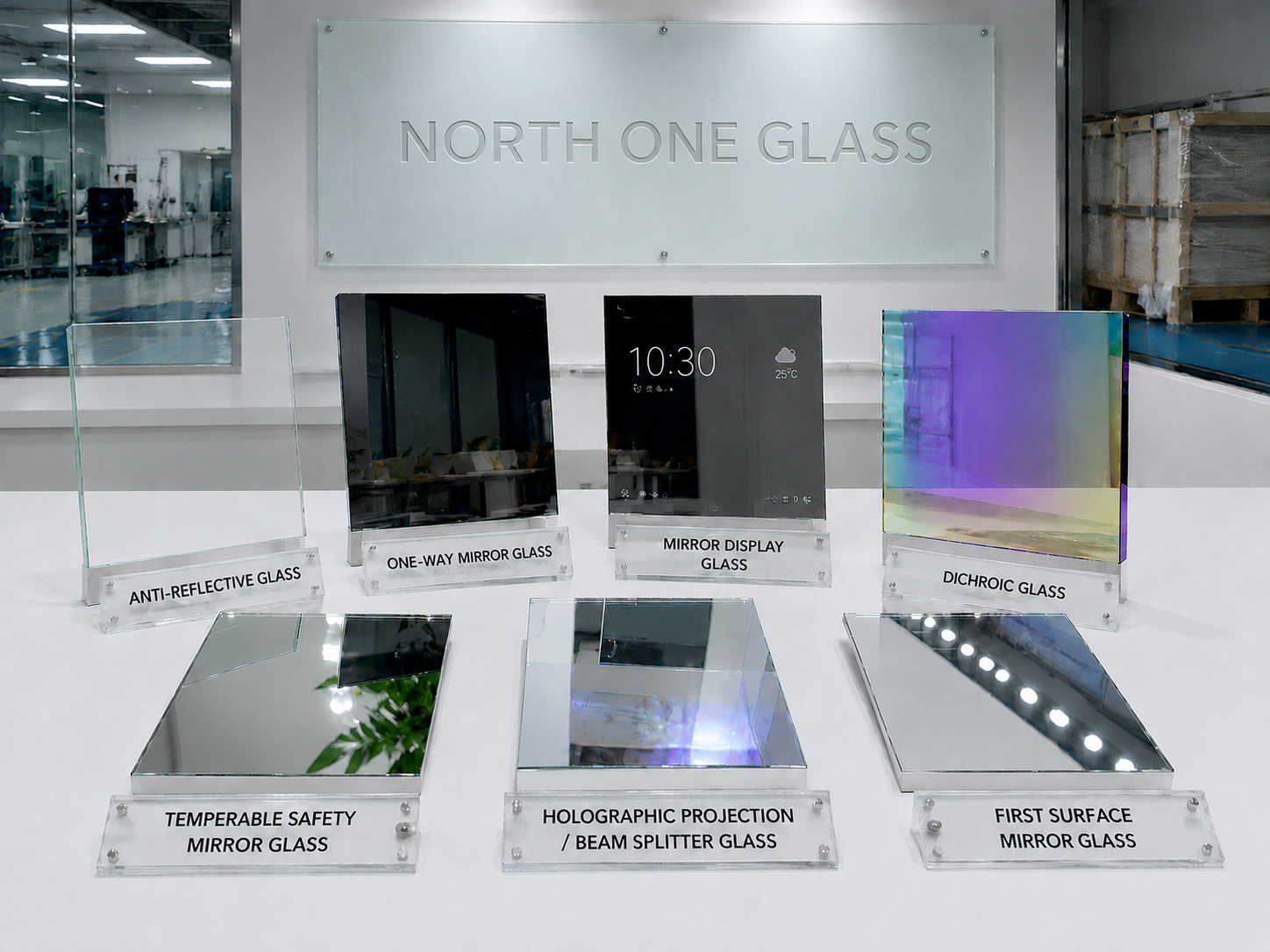
Open All Products product page Open Anti-Reflective Glass product page Open One-Way Mirror Glass product page Open Temperable Mirror product page Open Dichroic Glass product page Open Mirror Display Glass product page Open Holographic Projection Glass product page Open First Surface Mirror product page Open General Glass Knowledge product page
More filters

Showing 25-30 of 34 resources

Buyer guides

Latest buying guides

34 total resources
Featured guide Dichroic Glass Buying Guides

Dichroic Glass FAQ: Price, Colors, Tempering, Samples, MOQ, Packing and Outdoor Use

North One Glass dichroic glass is available in radiant orange, blue and green, with custom spectral matching. Raw-sheet references are about USD 15-25/m² by thickness and tempered finished glass is about USD 30-50/m². The coating supports tempering and deep processing, 5000-cycle scratch resistance, 20-year outdoor use and jumbo coating up to 3300 x 16000mm.

Read Guide
View Product Related FAQ Send RFQ
First Surface Mirror Buying Guides

First Surface Mirror Price, Specifications and Buying Guide

First Surface Mirror pricing depends on thickness, sheet or finished size, MOQ, precision processing, inspection and export packing. North One Glass supplies 95% visible-reflection front-surface mirrors in 1.1-15 mm thicknesses, standard sheets up to 3300 x 4880 mm and custom capability up to 3300 x 16000 mm. Request a quotation by drawing, quantity and application.

Read Guide
View Product Related FAQ Send RFQ
First Surface Mirror Buying Guides

Front Surface Mirror vs Second Surface Mirror: Differences, Cost and Selection Guide

A Front Surface Mirror reflects light from the coated front face before light travels through the glass, so it reduces ghosting, secondary refraction and optical loss. A second surface mirror places the reflective layer behind the glass and is easier to protect, but it can create double images in precision optical systems. Choose by optical accuracy, handling risk, cleaning method and cost.

Read Guide
View Product Related FAQ Send RFQ
First Surface Mirror Technical Knowledge

How First Surface Mirror Works: Manufacturing Process and Quality Inspection

A First Surface Mirror works by placing a high-reflectance optical film directly on the front surface of selected float glass. Light reflects immediately from the coating instead of traveling through glass first, which reduces secondary refraction and ghost images. Quality control should check 95% visible reflection, LAB color, film thickness, uniformity, cross-hatch adhesion and tape adhesion.

Read Guide
View Product Related FAQ Send RFQ
First Surface Mirror Buying Guides

First Surface Mirror Applications: Design Guide, Specifications and Project Scenarios

First Surface Mirrors are used where ghosting, optical loss or reflected-image distortion would damage the final system. Typical applications include laser projectors, engineering and home HD projectors, periscopes, optical turning systems, office and industrial scanners, 3D laser scanners, PCB inspection, semiconductor wafer inspection, automotive HUD, aerospace and laboratory optical systems.

Read Guide
View Product Related FAQ Send RFQ
First Surface Mirror Buying Guides

First Surface Mirror FAQ: Selection, Installation, Cleaning and Troubleshooting

This First Surface Mirror FAQ answers the procurement questions buyers usually ask before ordering: what it is, how it differs from ordinary mirrors, where it is used, which thicknesses and sizes are available, how to clean the exposed coating, how price is calculated, whether samples are supported, how long custom orders take and what to send for a quotation.

Read Guide
View Product Related FAQ Send RFQ