Anti-Reflective Glass Applications and Processing: Museums, Displays and Large Panels
AR glass is useful when surface reflection prevents the buyer from seeing the object, image or display behind the panel. The glass is only one part of the result: lighting, viewing distance, background, safety build-up, sealing, cleaning and support all affect the finished installation.
Application and Grade Selection
| Application | Starting AR route | Buyer problem solved | Details to confirm |
|---|---|---|---|
| Panoramic invisible house or high-end facade | Double-sided high-performance AR | Daylight mirror images and environmental reflections separate the building from the landscape | Wind load, safety build-up, sealing, jumbo handling and installation |
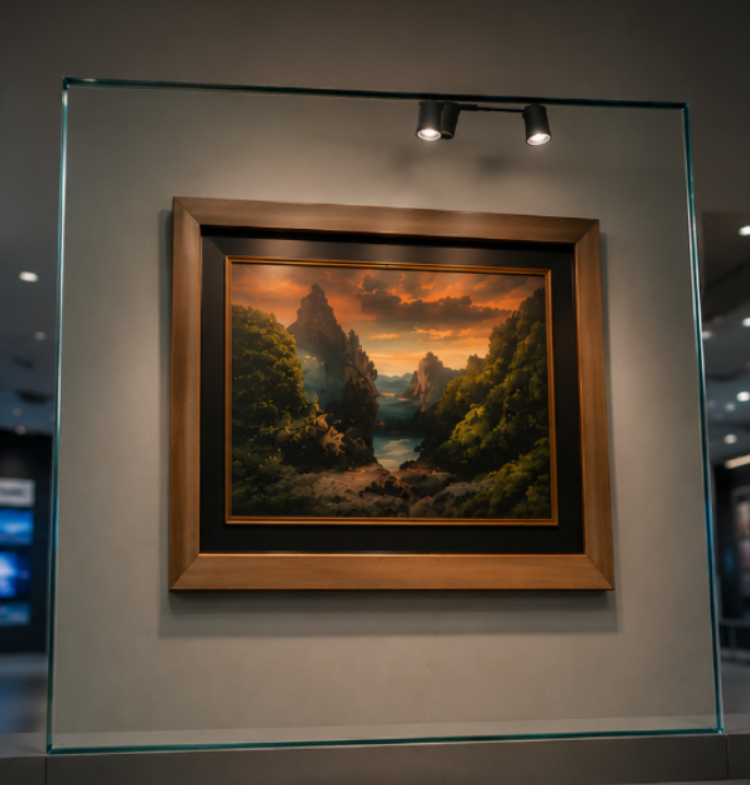
| Museum or gallery showcase | AR98; UV75/UV99 when UV filtering is required | Visitor reflections hide the object and UV accelerates aging | Lighting, UV target, safety, sealing and cleaning |
| Fine-art frame or artwork reproduction | Thin double-sided AR98 where suitable | Glass reflection changes color and detail | Substrate tone, frame rebate, coating side and handling |
| Luxury retail showcase | AR98 or another confirmed high-clarity route | Customers see glare instead of jewellery or watches | Panel size, edge finish, lighting and cleaning frequency |
| Tier-1 laptop, built-in oven or refrigerator touch panel | AR98/AR94 matched to the display | Strong light and oily environments reduce readability | Brightness, touch, printing, cleaning and tempering |
| Industrial-control, commercial display or outdoor LCD | AR94 or selected high-performance route | Bright surroundings reduce screen readability | Brightness, air gap, viewing angle and weather exposure |
| Holographic display, abyss mirror or precision optical instrument | AR outer anti-ghosting cover | Secondary surface reflections create duplicate images | Core optical glass, cover spacing, coating sides and assembly |
| Aquarium or optical viewing panel | High-clarity AR route | Reflections reduce viewing quality | Water pressure, thickness, support and sealing review |
In an abyss mirror or holographic display, AR glass is used as the outer cover to suppress secondary reflections and improve image purity. It does not replace the semi-reflective core glass. A one-way privacy window still requires one-way mirror glass rather than AR glass.
Four Core Application Scenarios
Panoramic Invisible Houses and High-End Facades
With up to 99% transmission and below 0.5% reflection for the confirmed double-sided route, AR glass eliminates visible mirror ghosting and environmental reflections in the designed daylight condition. This allows a panoramic cabin or facade to merge visually with forests, snow-covered mountains and natural landscapes. The project still needs an engineered safety build-up, wind-load review, seals, drainage, jumbo handling and installation planning.
Smart Appliances and Commercial Display Panels
Confirmed uses include cover glass for globally recognized Tier-1 laptop brands, high-end built-in ovens and refrigerator touch panels. High transmission, low reflection, 7H+ surface performance and the 5,000-cycle steel-wool result help the display remain bright, clear and cleanable under strong light and high-oil-fume environments.
Anti-Ghosting Covers for Advanced Displays
On holographic displays, abyss mirrors and precision optical instruments, AR glass serves as the outer optical cover. Reducing the secondary reflection from the cover surface improves image purity, reduces duplicate images and strengthens the perceived visual depth. The half-reflective functional layer remains a separate optical component.
Museum Showcases and Premium Display
AR98 provides a near-boundary-free view for museum showcases, gallery vitrines and luxury retail counters. UV75 and UV99 routes add ultraviolet protection for cultural relics, artwork, paper, textiles and high-value exhibits. Safety lamination, conservation materials, lighting, sealing and cleaning should be specified with the showcase system.
Confirmed Project References
- Dubai World Trade Centre exhibition-hall optical upgrade.
- Cover panels supplied for globally recognized Tier-1 laptop brands.
- High-clarity and ultraviolet-protection glazing for national-museum showcase systems.
- Smart-appliance cover glass for built-in ovens and refrigerator touch panels.
Processing Route
North One Glass supports custom cutting, edge grinding, CNC waterjet drilling, notches, C-corners, curved edges, 700°C physical tempering, chemical strengthening and PVB/SGP lamination for the selected AR configuration. Confirmed coating adhesion keeps the film edge intact through the approved cutting and finishing route. A production drawing should show: PVB and high-strength SGP can be used to build safety, blast-resistant or project-specific ballistic laminated assemblies, subject to the complete construction, structural calculation and required test standard. AR glass can also be combined with Low-E glass in an IGU to provide high clarity together with thermal and acoustic performance. For large panels, the factory should review the raw-sheet format and handling route before promising the finished size. Maximum capability can reach 3,300 x 16,000mm, but grade, thickness, processing, packing, transport and site lifting still control what is practical.
- finished length and width for every size;
- edge finish, radius, bevel, notch and hole positions;
- coating side and any protected edge requirement;
- safety build-up such as 5+1.14PVB+5 or 6+1.14PVB+6;
- IGU build-up such as 5+12A+5 or 6+16A+6, including the Low-E layer and cavity design;
- tolerance, inspection and sample approval conditions.
Cleaning and Maintenance
The approved everyday cleaning statement allows standard commercial glass cleaner without coating damage under normal conditions. For a maintenance team, the practical routine is simple: The coating passed 5,000 reciprocating steel-wool rubbing cycles without peeling or visible damage under the approved test. That durability result does not make the surface immune to sand, metal contact or poor storage.
- Remove loose dust and grit before wiping.
- Use a clean soft cloth and a suitable commercial glass cleaner.
- Wipe with light pressure; do not use metal blades or abrasive pads.
- Keep rubber, metal and dirty separators away from the coated surface during storage and installation.
- Record the coating side and cleaning method in the handover documents.
Export Packing and Site Risk
Export orders use fully enclosed fumigation-free reinforced wooden crates with anti-mildew paper or polymer powder between sheets, internal steel straps, shock-resistant timber bases and moisture protection. Full transport insurance is arranged for each confirmed shipment. The crate design should match the finished size, edgework, mixed-size loading, lifting equipment, route and unloading conditions. For a large museum or display project, include the crate opening sequence and site storage conditions in the logistics discussion. The packing system is designed for zero-breakage delivery through long-distance sea transport and humidity changes, while correct unloading, inspection and storage remain part of the receiving procedure. See the AR product family, the AR product page and the AR price guide.
FAQ
Q1: Is AR98 necessary for every museum case?
Not necessarily. AR98 is the premium clarity starting route, while the final decision also depends on UV protection, safety construction, lighting, size, budget and conservation requirements.
Q2: When should UV75 be selected?
Select UV75 when reducing ultraviolet exposure is part of the preservation requirement for paintings, paper archives, historical documents, textiles or valuable exhibits.
Q3: Can AR glass be made into laminated museum glass?
Yes. AR glass can be reviewed for lamination, including structures such as 5+1.14PVB+5 or 6+1.14PVB+6. The matching layers, yield, inspection and packing must be quoted together.
Q4: Can AR glass be drilled after coating?
Drilling is an approved processing route, but the hole drawing, edge distance, thickness, coating side and any later tempering must be reviewed before production.
Q5: What is the most common installation mistake?
Ordering by total area alone and ignoring finished sizes, coating side, support, sealing, air gap, cleaning and lifting. These omissions create yield, optical and breakage problems later.