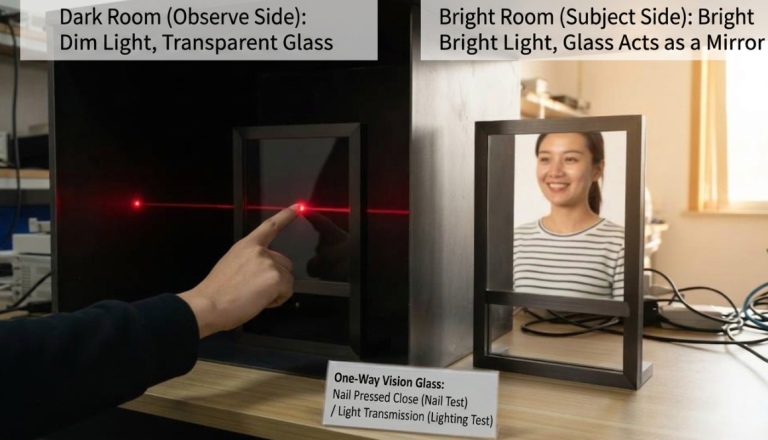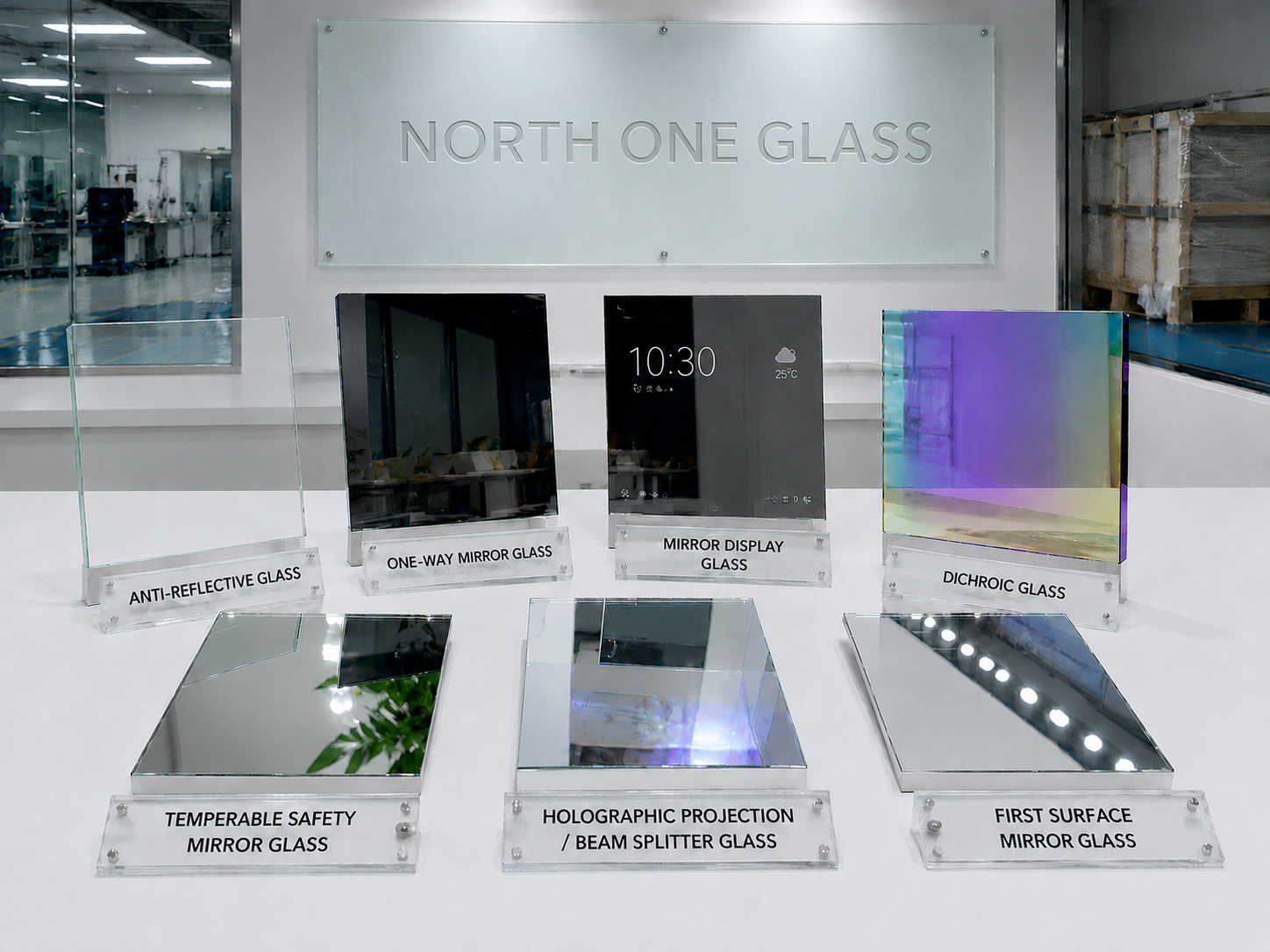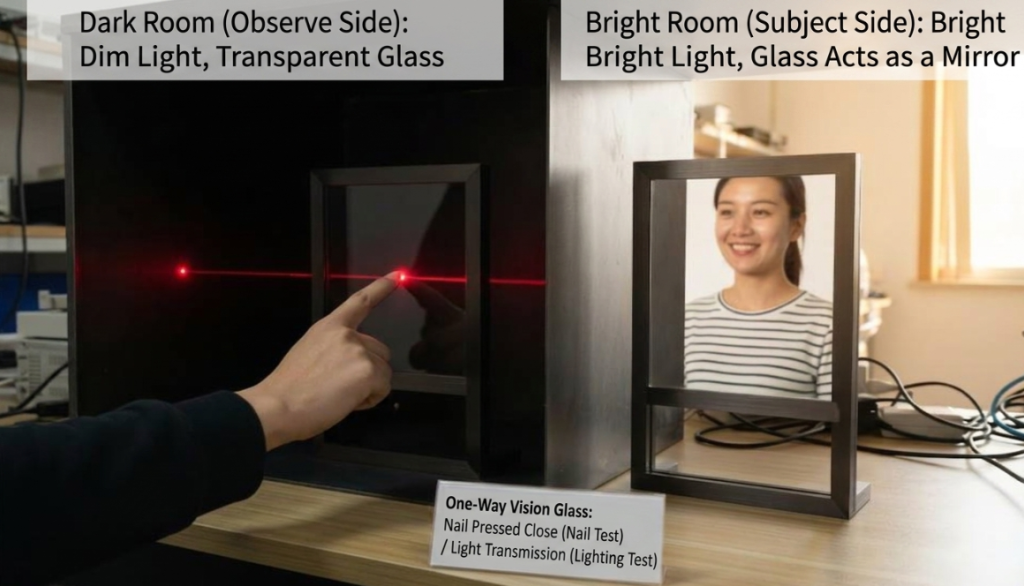
One-way mirror glass works only when one side is clearly brighter than the other. In most observation rooms, the observed room should stay bright and the observer room should stay dark. A T15/R75 glass can give the bright side a mirror effect while the dark side sees through, but the effect can fail at night or under wrong lighting. Check the room first, then choose the glass.
The Short Version
If a buyer asks, "Will this glass be private from one side?" the honest answer is: only if the room is designed for it. The glass does not know which side is private. It reflects and transmits light at the same time. The lighting decides which side wins. Before asking for a quotation, take two photos of the place where the glass will be installed: one from the bright side and one from the dark side. If both sides look equally bright in the photos, the one-way effect will probably be weak. If the observer side has bright lamps, white walls, computer screens, or sunlight behind the viewer, the person on the other side may see movement behind the glass.
Where It Usually Works
| Use place | Good sign | Risk sign |
|---|---|---|
| Observation room | The observed room is much brighter, and the observer room stays dark. | Observer room has bright lamps, white walls, or screens near the glass. |
| Interview or security room | The lighting plan is controlled and the glass position is fixed in the drawing. | The buyer only sends size and asks for "one-way privacy" without room details. |
| Office privacy partition | Corridor side is brighter most of the day and the private side is dimmer. | Lighting changes after work, at night, or when blinds are closed. |
| Infinity mirror or stage effect | There is a dark background and strong LED or display lighting. | The final panel is much larger than the tested sample, or the background is bright. |
| Outdoor cabin or facade | Daytime exterior is brighter than the interior. | Interior lights turn on at night and the outside becomes dark. |
A Simple Test Before You Buy
Stand on the side that should look like a mirror. Is that side brighter than the other side? If yes, the effect has a chance. Now stand on the viewing side. Is this side darker, with no strong light behind your head? If yes, the see-through side has a chance. Then repeat the same check at night. Many projects pass the daytime test and fail at night. This is especially common for office partitions, villas, cabins, retail rooms, and exterior glazing. If the customer expects privacy after sunset, the lighting plan matters as much as the glass. For a serious project, do not approve the glass from a desk sample. Put the sample near the real opening, use the real lamps, and view it from the real angle. Mark which face is the coating side before the sample leaves the factory.
The T15/R75 Starting Point
North One Glass normally uses T15/R75 as the standard reference for one-way mirror glass: about 15% visible light transmission and 75% visible light reflection. In plain language, it is reflective enough for the bright side to read as a mirror, while still allowing the darker side to observe through the panel. Other transmission/reflection ratios can be reviewed, but the ratio should not be chosen from a number alone. A higher reflection can strengthen the mirror side, but it can also make the see-through side darker. A higher transmission can help the observer see through, but it may weaken the mirror effect. The right balance depends on room brightness, glass size, viewing distance and what the buyer is trying to hide or observe.
Do Not Forget The Coating Side
For this product, orientation should be treated as part of the order, not something the installer guesses on site. Samples and production glass should be marked. If the glass will be laminated, tempered, or made into insulated glass, the coating position should be shown in the drawing. This is one of the easiest mistakes to avoid. Write the viewing direction on the drawing. Write which side should face the brighter room. Ask the supplier to label the glass and packing. It sounds small, but it can prevent a very expensive installation argument.
Raw Sheet Price Is Not The Same As Finished Glass
I am not putting a public price table here yet because the useful price for one-way mirror glass depends on the actual build-up. A raw coated sheet, a tempered panel, a laminated safety panel, and a large insulated unit are different quotations. The main price drivers are simple:
If you only send "one-way mirror glass, 10 mm, how much per square meter," the first price will be rough. If you send drawings and room use, the quotation can become much more useful.
- thickness and glass build-up;
- finished size and cutting yield;
- whether the glass needs tempering, lamination, holes, notches or polished edges;
- whether the project uses standard T15/R75 or a custom optical ratio;
- crate size, coated-surface protection, inland transport and export packing;
- how many different sizes are in the same order.
What North One Glass Can Review
North One Glass supplies one-way mirror glass, also called two-way mirror glass, for observation rooms, privacy spaces, infinity mirrors, outdoor visual projects and custom coated-glass applications. The normal reference is T15/R75, and custom ratios can be discussed when the room and lighting are clear. Processing can be reviewed for cutting, edging, drilling, tempering, lamination and insulating-glass construction, depending on the selected product route. Large coated-glass projects can also be checked against the 3300 x 16000 mm capability, but the final workable size still depends on processing, lifting, packing and transport.
What To Send For A Useful Quotation
- What is the place: observation room, office partition, cabin, facade, infinity mirror, display, or another use?
- Which side should see through?
- Which side should look like a mirror?
- Photos or sketches showing lights, windows, wall color and viewing direction.
- Day and night lighting conditions if privacy matters after sunset.
- Standard T15/R75 or a custom optical target.
- Glass thickness and build-up: monolithic, tempered, laminated or insulated glass.
- Finished size, quantity, edgework, holes, notches and drawings.
- Coating direction requirement and labeling requirement.
- Destination, packing requirement and schedule.
Common Mistakes
- Buying the glass first and thinking about lighting later.
- Testing the sample with a phone flashlight.
- Forgetting the night condition.
- Using a bright observation room because people want it comfortable inside.
- Comparing film and coated glass only by material price.
- Not deciding whether the final glass should be tempered or laminated.
- Using observation-grade one-way mirror glass for a smart mirror display without checking screen brightness.
Related Pages
- One-Way Mirror Glass category
- One-Way Mirror Glass product page
- One-Way Mirror Glass vs Film
- Mirror Display Glass vs One-Way Mirror Glass
- Send a project RFQ
FAQ
Does one-way mirror glass work at night?
It works at night only if the observed side is still brighter than the observer side. If the interior becomes bright and the outside is dark, the effect can reverse.
Is one-way mirror glass really one way?
No. The glass reflects and transmits light from both directions. People call it one-way because the lighting makes one side behave like a mirror and the darker side able to see through.
Is T15/R75 always the best choice?
It is a practical starting point, not a universal answer. The right ratio depends on room brightness, viewing distance, mirror effect, see-through clarity and safety construction.
Can it be tempered or laminated?
It can be reviewed for tempering, lamination, cutting, edging, drilling and insulating-glass construction when the selected route allows it. Confirm the full process before ordering.
When should I avoid one-way mirror glass?
Avoid it when both sides will stay similarly bright and the buyer expects permanent privacy. In that case, the problem is not only glass selection; it is the room design.