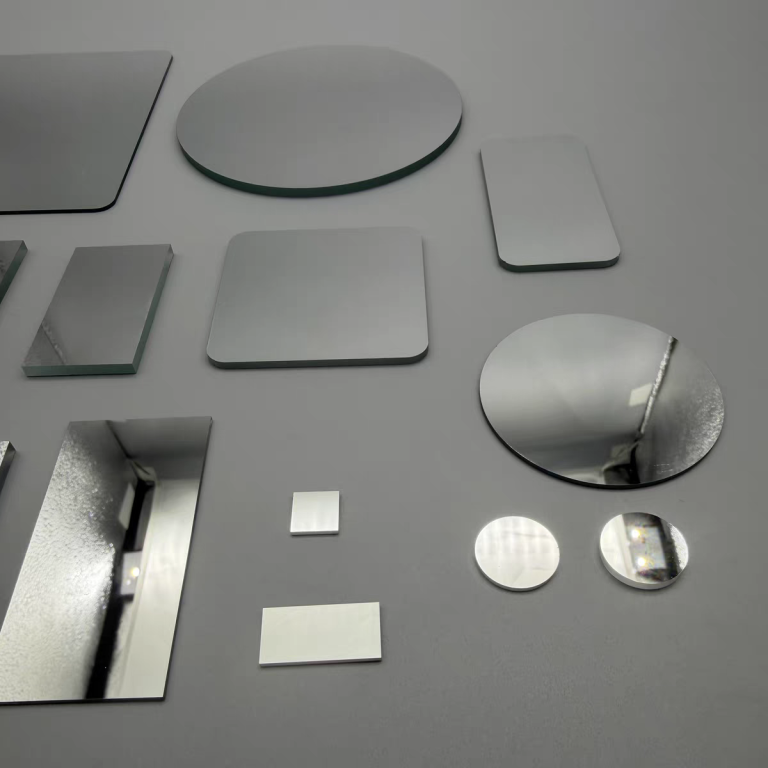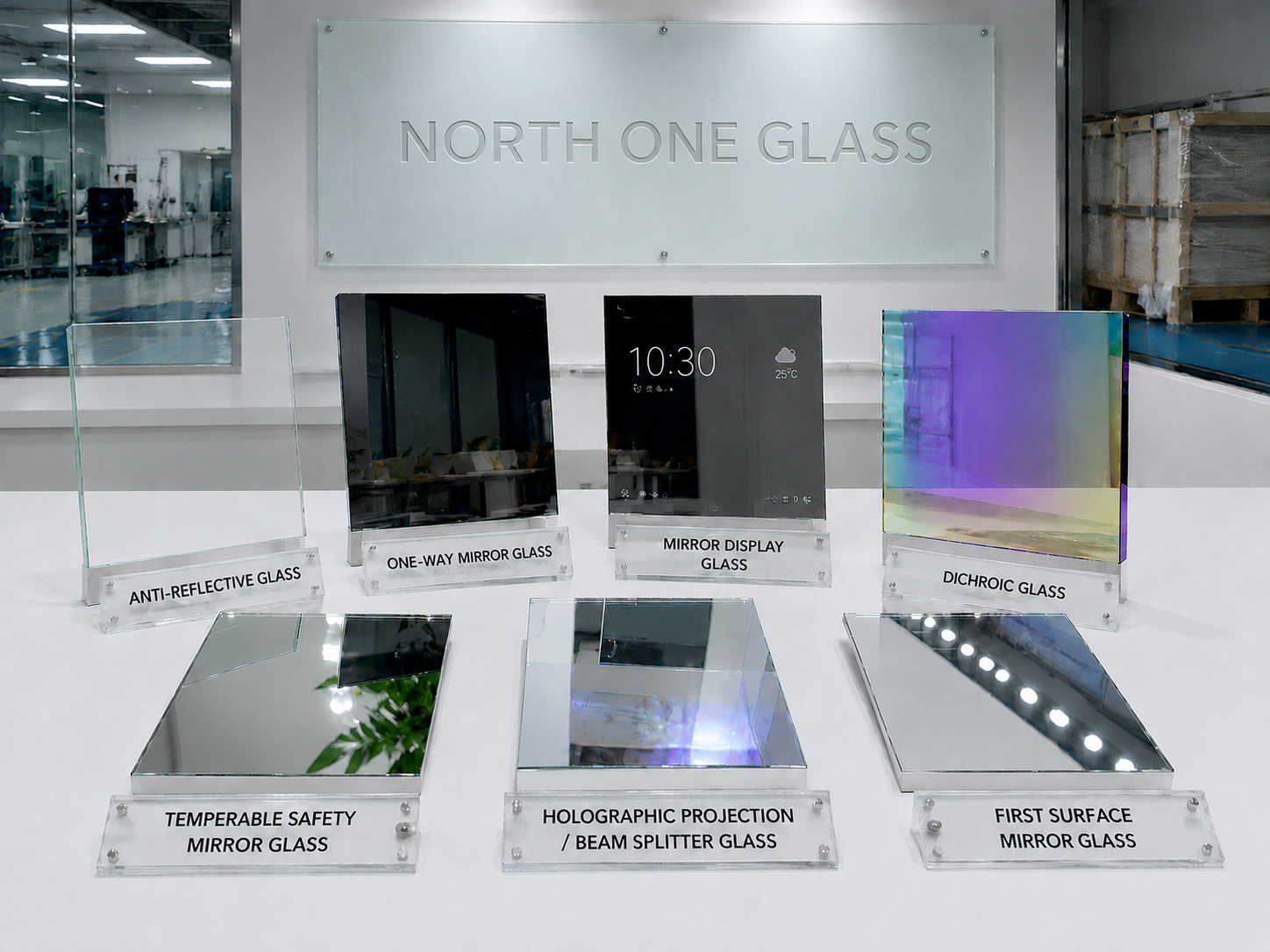
A first surface mirror places the reflective optical coating on the front face, so light reflects before passing through the glass substrate. A conventional second surface mirror places the reflective layer behind the glass. Light crosses the glass, reflects, and crosses it again, which can create a weaker secondary reflection or ghost image.
TL;DR
- Choose a first surface mirror when ghost-image control, path accuracy, image sharpness, or optical efficiency is critical.
- Choose a second surface mirror when the glass-protected reflective layer and conventional mirror handling are more important than eliminating the secondary reflection.
- A first surface coating is exposed. Handling, cleaning, mounting, packaging, and environmental protection must be designed around that fact.
Optical path difference
In a second surface mirror, the front glass surface reflects a small portion of light before the main reflection returns from the rear coating. The separation between those reflections depends on glass thickness, angle, refractive index, and geometry. For ordinary viewing this may be acceptable. In projection, scanning, imaging, measurement, teleprompter, or folded optical paths, the extra image can reduce precision or contrast. The first surface design removes the substrate from the incoming reflective path. That does not mean every first surface mirror has the same performance. Reflectance depends on wavelength, angle, polarization, coating system, substrate, and measurement method. Flatness, surface quality, coating uniformity, and mechanical mounting may be just as important as a headline reflection value.
Procurement checklist
Use the First Surface Mirror category for the selection framework and review the 95% first surface mirror product for product specifications. Other optical and coated glass families are listed in the products hub.
- Define wavelength range, incidence angle, polarization, and target reflectance.
- State image or beam size, optical flatness, surface quality, distortion, and ghost-image limits.
- Provide substrate, dimensions, thickness, tolerances, edgework, holes, and shape.
- Identify the coating side and orientation in drawings and packaging.
- Describe handling, cleaning, mounting, humidity, abrasion, and enclosure conditions.
- Agree on inspection method, approved sample, packing, quantity, and destination.
Handling is part of the design
Because the optical coating is accessible, avoid touching it with bare hands and prevent hard particles from being dragged across the surface. Specify suitable separators, clean gloves, supported mounting, and an approved cleaning method. Do not transfer cleaning claims from a rear-coated household mirror to an exposed optical coating.
FAQ
Why does a second surface mirror create a ghost image?
Light can reflect weakly from the front glass surface before the main reflection returns from the coating behind the glass, creating two separated reflected paths.
Is a first surface mirror always the better choice?
No. It is preferred when optical path quality justifies an exposed coating. A protected second surface mirror may be more practical where minor ghosting is acceptable and handling conditions are demanding.
What information is needed for an optical mirror quotation?
Send wavelength, angle, reflectance target and test method, flatness and surface requirements, drawing, coating orientation, environment, handling needs, quantity, and destination through the contact page.