


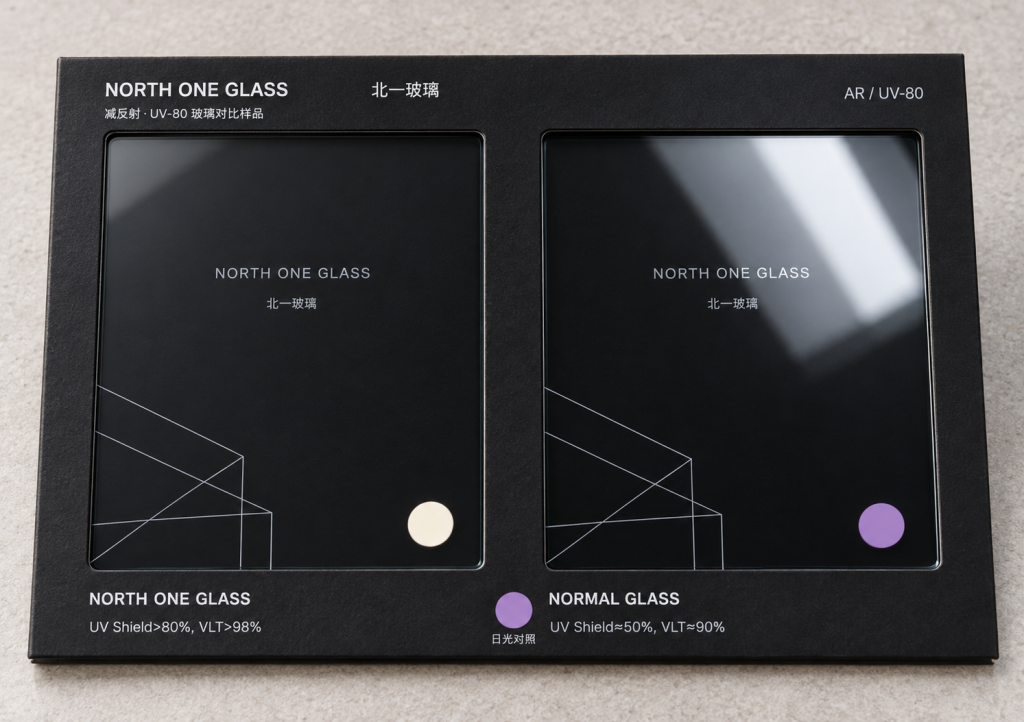
Thirteen candidate samples. A critical UV measurement finding. European laboratory approval. A trial order followed by a long-term supply agreement.
The engineering and commercial team now operating as North One Glass developed UV Shield 80, a high-transmission, UV-blocking anti-reflective glass solution for a European picture-framing customer. The project began in early 2025 with a demanding combination of optical performance, coating durability, competitive pricing and customized export packaging.
The first coating design looked promising: its arithmetic-average UV transmittance across 280–380 nm was below 20%. However, when the team applied the EN 410 UV-weighted method, it achieved only 68% UV rejection—short of the customer’s greater-than-80% target. After investigating the reference glass, revisiting the coating materials and evaluating 13 candidate samples, the team arrived at a design that passed the customer’s laboratory evaluation in Europe.
Project at a Glance
| Project detail | Description |
|---|---|
| Application | Premium picture framing and display of artwork |
| Customer | European picture-framing business (identity confidential) |
| Base glass | 2 mm low-iron float glass |
| Product | UV Shield 80, UV-blocking anti-reflective glass |
| Main challenge | Combine high visible transmission, low visible reflection and EN 410-weighted UV reduction |
| Development iterations | 13 candidate samples evaluated |
| Independent verification | Customer-submitted samples tested by a European laboratory |
| Commercial outcome | Trial order, successful trial supply and a long-term supply agreement |
Customer Requirements: Clarity, UV Protection and Practical Supply
The customer wanted framed artwork to remain easy to see while reducing UV radiation passing through the glazing. The glass also needed a durable coating suitable for normal cleaning, a price competitive with European alternatives, and packaging appropriate for distribution.
The initial technical brief specified:
| Property | Customer specification |
|---|---|
| Glass thickness | 2 mm low-iron float glass |
| Visible light transmittance | Greater than 98.5%, using the specified 380–780 nm visible-light evaluation range |
| Visible light reflectance | Below 1%, under the agreed measurement configuration |
| UV rejection | Greater than 80% across 280–380 nm using the EN 410 solar-UV weighting method |
| Coating durability | Good resistance to handling and agreed cleaning conditions |
| Packaging | Four sheets per branded carton, with outer wooden export protection |
Measurement note: Visible-light evaluation uses 380–780 nm, matching the visible interval in the current technical data sheet. The reference visible transmission uses D65 weighting. UV rejection over 280–380 nm was separately assessed with the specified EN 410 weighting method. Keeping these methods distinct was crucial to evaluating the product correctly.
First Prototype: Why an Average UV Result Was Misleading
The first prototype was developed within approximately two weeks. It performed well in initial visible-light tests, while the simple arithmetic mean of UV transmittance over 280–380 nm was below 20%.
That result alone was not enough. Applying the EN 410 solar-UV spectral weighting produced a UV rejection result of 68%—well below the required 80% threshold.
The discrepancy was an important engineering finding. A simple mean treats sampled wavelengths equally, while a weighted calculation gives different spectral regions different influence. Two coatings with similar average UV transmittance can produce materially different EN 410-weighted results.
Rather than treating the promising average as a pass, the team used the weighted result to guide the next development stage.
Coating Optimization: Thirteen Samples, One Selected Design
The team compared the prototype’s measured spectrum against the reference glass supplied by the customer. The comparison pointed to a different UV attenuation profile and prompted a review of coating-material selection, absorption behavior and interference design.
North One Glass’s engineers led the optical analysis, design direction, material selection and sample evaluation. Several material and coating configurations were trialed, resulting in 13 candidate samples.
The candidates were assessed against the full set of optical requirements rather than ranked by visible transmission alone. The selected solution combined high transmission, low reflection and the required weighted UV attenuation.
The resulting product became UV Shield 80.
European Laboratory Approval and Commercial Results
The customer received the optimized samples and sent them to an established laboratory in Europe for evaluation. According to the customer’s testing feedback, the selected glass met the agreed optical requirements.
| Evaluation criterion | Outcome |
|---|---|
| High visible transmittance under the agreed method | Passed customer evaluation |
| Low visible reflectance under the agreed method | Passed customer evaluation |
| Greater than 80% weighted UV rejection | Passed customer evaluation |
The customer then placed a trial order. Following successful trial supply, the customer signed a long-term supply agreement with North One Glass.
Cost was also important to the buying decision. In this sourcing project, North One Glass offered a price of approximately two-thirds of the European alternative considered by the customer, while delivering better results against the optical performance criteria relevant to the project. The comparison describes the customer’s sourcing decision, not a universal price or performance claim about all European glass products.
What the Project Demonstrates
Optical targets must use defined calculations. An arithmetic-average UV transmittance figure cannot be substituted for an EN 410-weighted rejection value.
Good AR performance and good UV reduction are separate requirements. They must be measured and optimized together, especially for artwork display.
Engineering capability and cost competitiveness can reinforce each other. The project required material and spectral problem-solving as well as practical packaging, pricing and export delivery.
Third-party evaluation matters. The decisive milestone was not the internal prototype result; it was the customer’s independent laboratory assessment followed by real purchase orders.
Frequently Asked Questions
What is UV Shield 80 glass?
UV Shield 80 is North One Glass’s high-transmission anti-reflective glass with UV-reducing performance, developed for applications such as picture framing and art display glazing.
Can anti-reflective glass also reduce UV transmission?
Yes. Coating materials and layer designs can be engineered to reduce reflections in the visible spectrum while also attenuating UV radiation. The two performance characteristics require separate measurements.
Why was the first sample’s UV rejection only 68% when average UV transmittance was below 20%?
The arithmetic average and the EN 410 UV-weighted calculation use different methods. The shape of a glass sample’s transmittance spectrum affects the weighted result, so a favorable simple average does not guarantee a pass.
Is UV Shield 80 equivalent to UV99 conservation glazing?
No. An approximately 80% UV-rejection product and a UV99 product represent different protection levels. Comparisons require identical wavelength limits, calculation methods and test conditions.
What documents should framing-glass buyers request?
Ask for a product-specific optical test report, spectral curves, calculation method, thickness, coating durability evidence, size availability and packaging specification.
Discuss UV Shield 80 for Your Application
If you source glazing for picture frames, galleries, artwork displays or glass distribution, North One Glass can review your required optical performance, glass dimensions, packaging and supply plan.
Related product: Anti-Reflective Glass
North One Glass — Transmit. Reflect. Protect.
See the Art. Not the Glass. Block UV. Not the View.