


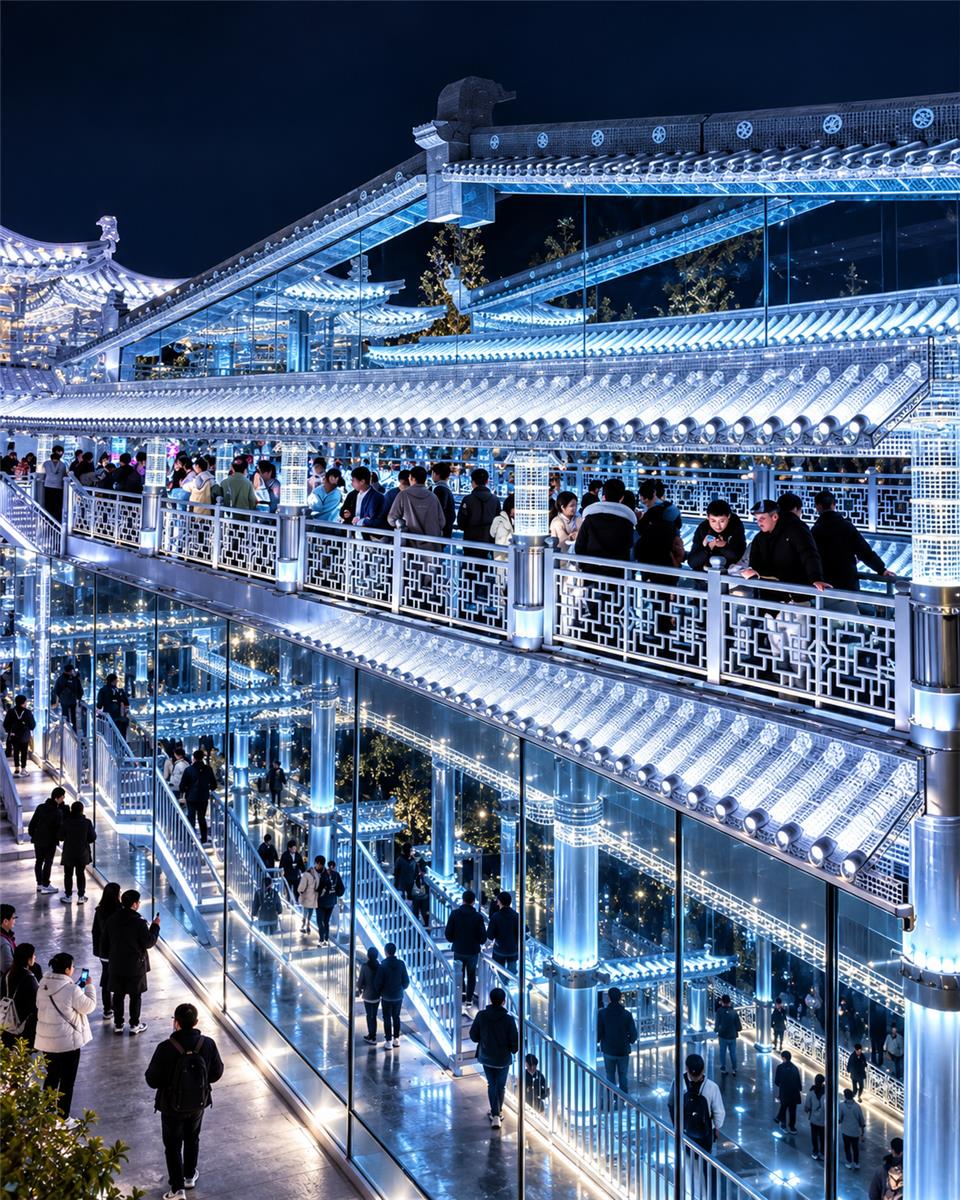
A 2440 × 5500 mm finished mirror panel. An 8 + 1.14 PVB + 8 laminated glass construction. A four-day first prototype—and an optical detail solved in the second design.
In 2025, the team behind North One Glass worked on a large-format mirror installation for Wansui Mountain Scenic Area in Kaifeng, Henan, China. The project called for opposing outdoor mirrored walls that would reflect one another and create a dramatic sense of visual depth.
The customer needed a mirror assembly suitable for a busy public attraction, capable of being manufactured at a finished size up to 2440 × 5500 mm, and delivered on a demanding project schedule.
The selected solution combined heat-treatable magnetron-sputtered mirror glass, tempering and lamination. When initial testing revealed faint wall visibility through the mirror under strong lighting, North One Glass introduced a black PVB interlayer to improve opacity. The updated samples were approved, followed by a large-format sample order and a bulk order.
Project at a Glance
| Project detail | Specification |
|---|---|
| Location | Wansui Mountain Scenic Area, Kaifeng, Henan, China |
| Application | Outdoor opposing mirror walls / immersive landscape installation |
| Largest finished panel | 2440 × 5500 mm (2.44 × 5.5 m) |
| Final glass build-up | 8 mm tempered mirror glass + 1.14 mm black PVB + 8 mm tempered glass |
| Nominal total thickness | 17.14 mm |
| Reflective coating | Heat-treatable magnetron-sputtered mirror coating, positioned inside the laminate |
| First prototype | Produced in four days; delivered within five days |
| Product refinement | Black PVB interlayer used to reduce background show-through |
| Commercial result | Large-format sample order followed by bulk order |
The Challenge: Mirror Walls in an Outdoor Public Space
The design concept depended on facing mirror surfaces and continuous reflections. Large reflective sheets reduced the visual interruption of seams, but their size and installation environment created multiple engineering constraints.
Public-Space Safety
Tourists could come into contact with the mirrored walls. Accidental impact or deliberate damage were foreseeable risks, making the behavior of the glazing after breakage important—not just the strength of an intact panel.
Outdoor Exposure
Conventional silver-backed mirrors can deteriorate when water reaches the reflective backing or exposed edges. The customer wanted an approach with better protection of the reflective layer against outdoor exposure.
Oversized Finished Panels
The largest actual finished panel measured 2440 × 5500 mm, requiring a planned sequence of coating, tempering, lamination, handling and protective packing. This was an as-manufactured project dimension, not a theoretical machine capacity.
A Tight Project Schedule
The customer requested samples within five days, an agreed technical solution within 15 days, construction preparation in roughly one month and an overall delivery goal of approximately two months. These were project targets; the confirmed case milestones are the sample work and subsequent orders described here.
The Glass Solution: Tempered, Laminated and Coating-Protected
North One Glass selected a heat-treatable mirror glass made using a vacuum magnetron-sputtered reflective coating. The coated glass was processed into a tempered laminated mirror assembly, with the reflective layer oriented toward the laminated interior rather than exposed directly to the outdoor environment.
The final approved build-up was:
8 mm tempered mirror glass / 1.14 mm black PVB / 8 mm tempered glass
This construction was chosen for three functions:
- Glass strength and fragment retention. Tempering improves the glass’s mechanical behavior, while the laminate helps hold broken fragments in place in the event of breakage.
- Coating protection. Positioning the mirror layer inside the laminated construction limits its direct environmental exposure.
- Visual opacity. The black interlayer reduces the visibility of light that passes through the reflective coating.
For public installations, glass selection is only one part of safe design. Fixings, edge clearances, structural loads, fall prevention and the completed support system must be engineered for the site.
First Prototype: A Small Optical Effect with a Big Visual Impact
The team made the first prototype in four days, meeting the customer’s requirement for sample delivery within five days.
The customer liked the reflection and the laminated safety concept. But under strong lighting, part of the wall behind the mirror remained faintly visible. The initial mirror glass transmitted approximately 1% of incident light; in this application, even that small amount could compromise the intended uninterrupted mirror effect.
The issue was not primarily the mirror’s apparent reflectivity. It was background show-through when lighting conditions made the material behind the glass visible.
Second Prototype: Black PVB to Suppress Background Show-Through
Rather than rebuilding the whole coating system, North One Glass refined the laminated assembly. The team selected a 1.14 mm black PVB interlayer behind the reflective glass.
The reflective coating continued to produce the mirror image, while the dark interlayer absorbed or concealed transmitted light and helped prevent the underlying wall from showing through.
The second sample delivered the visual improvement the customer needed. Following approval, the customer placed an order for large-format samples and later a bulk order.
The final case sequence was straightforward:
Requirement review → First sample in four days → Strong-light evaluation → Black PVB optimization → Second-sample approval → Large-format order → Bulk order
Engineering Lessons from the Project
Mirror Opacity Is Not the Same as High Reflectance
A reflective glass panel can still transmit a small percentage of light. For an installation backed by a contrasting wall and exposed to strong illumination, low residual transmission can be visually important.
Lamination Can Serve Both Safety and Optical Design
The laminate helps retain fragments after breakage. In this project, the carefully chosen black PVB also helped control background visibility.
Large-Format Glass Requires a Complete Processing Route
A 5.5-meter finished mirror panel depends on compatibility among coating, tempering, lamination, handling and logistics—not only the dimensions of the base glass.
Fast Sampling Helps Identify Real-World Issues
The strong-light show-through problem became apparent during customer evaluation. A targeted second prototype resolved the issue before the project moved into further ordering.
Frequently Asked Questions
Can mirror glass be tempered and laminated?
Yes, when the reflective coating is compatible with the specified heat-treatment and lamination processes. Conventional mirror constructions and heat-treatable sputtered mirror systems are not interchangeable.
What was the finished glass size in the Wansui Mountain project?
The largest finished panel was 2440 × 5500 mm, or 2.44 × 5.5 meters.
What was the final laminated glass structure?
The final construction was 8 mm tempered mirror glass + 1.14 mm black PVB + 8 mm tempered glass, for a nominal thickness of 17.14 mm.
Why use black PVB behind a mirror coating?
The black interlayer reduces the appearance of residual transmitted light, helping conceal the wall or support behind the reflective glass under strong lighting.
Does tempered laminated mirror glass automatically make an outdoor wall safe?
No. Glass build-up, tested performance, panel support, fixings, wind and impact loads, edge protection and applicable local regulations all matter to a safe installation.
Planning a Large-Format Mirror Glass Project?
North One Glass supports customized heat-treatable mirror glass, precision processing and large-format laminated glass solutions for architecture, themed attractions and landscape design. Share your finished dimensions, required build-up, viewing conditions and installation details so the appropriate manufacturing route can be reviewed.
North One Glass — Transmit. Reflect. Protect.