What Is T30 Mirror Display Glass?
How Dielectric Smart Mirror Glass Works
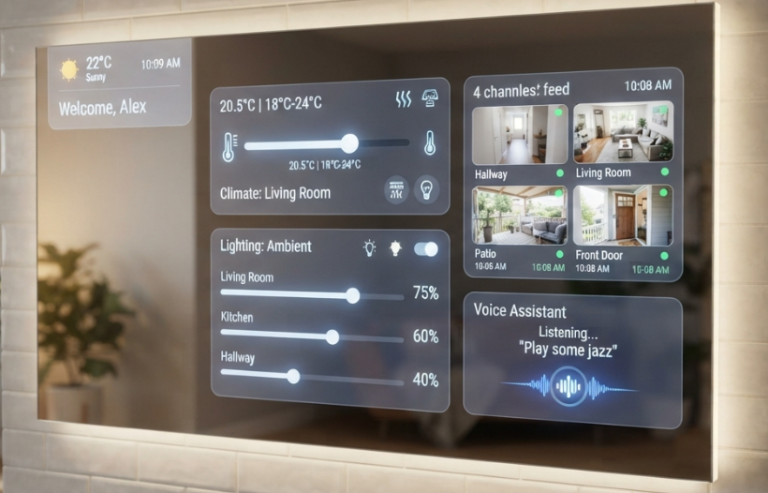
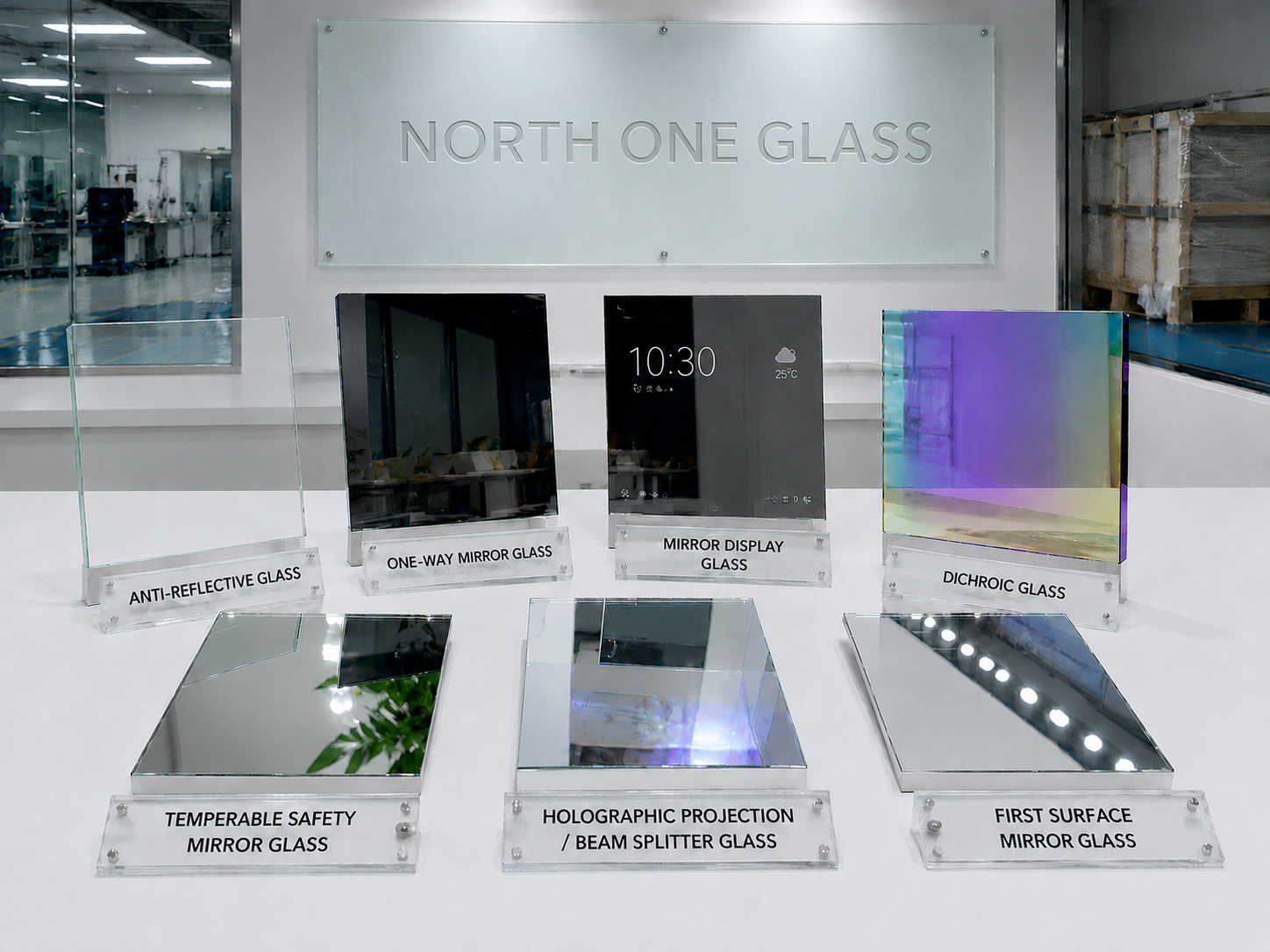
T30 mirror display glass is designed for products that must look like a mirror when the screen is off and become a clear digital display when the screen is on. Its common T30/R70 optical balance provides about 30% visible light transmission and 70% reflection. The key difference from ordinary one-way mirror glass is the multilayer dielectric coating: it is non-conductive, has very low light absorption and is better suited to capacitive touchscreens and color-sensitive displays.
What the Buyer Is Actually Choosing
A smart mirror project is not simply choosing reflective glass. The buyer is balancing four results:
| Buyer Requirement | What the Glass Must Do |
|---|---|
| Mirror appearance when the screen is off | Provide enough reflection to hide the black display area and internal structure |
| Bright image when the screen is on | Transmit enough screen light without making the image look dull |
| Natural display color | Avoid strong grey, blue or green color shift |
| Stable touch response | Avoid conductive coatings that interfere with capacitive touch signals |
T30/R70 is a common starting point because it gives a strong mirror appearance while allowing a properly selected screen to remain visible. T50/R50 can be reviewed when display brightness is more important than hiding the screen.
Production Principle
North One Glass starts with selected float glass. The substrate is cleaned with deionized water and dried before entering a large vacuum magnetron sputtering coating line. Multilayer dielectric oxide materials are deposited in a controlled film structure to create the required transmission, reflection and neutral mirror color. This process is different from applying a plastic film to ordinary glass. The optical coating is produced on the glass surface under vacuum, so the finished sheet can be reviewed for cutting, edging, drilling, physical tempering, silk-screen printing, lamination and insulating-glass processing.
Screen Off and Screen On
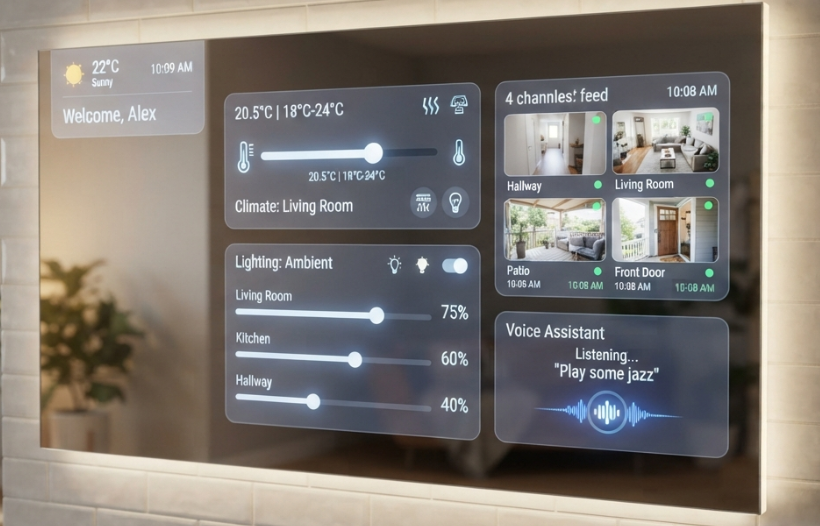
When the screen is off, ambient light reflects from the T30/R70 surface and the black display area is visually hidden. When the screen is on, light from the LCD or OLED passes through the glass and becomes visible to the user. The result still depends on the complete assembly. A low-brightness screen in a brightly lit room may look weak even when the glass specification is correct. Buyers should test the chosen screen, glass, air gap, black border and ambient lighting together.
Why the Non-Conductive Coating Matters
Traditional one-way mirror glass generally contains metallic coating components. These coatings can shield or disturb the electric field used by a capacitive touchscreen. The result may be delayed response, dead zones or unstable touch behavior. Dielectric mirror display glass uses a high-resistance, non-conductive coating. This makes it the more appropriate route for interactive fitness mirrors, bathroom touch mirrors, appliance control panels and other products where the touch sensor must work through the glass.
Tempering, Color and Durability
The T30 mirror display route is designed for high tempering yield and stable color before and after physical tempering. This matters to processors because some coated products can crack, blister, yellow or shift color during the tempering cycle. The approved product facts also include 5,000 steel-wool rubbing cycles without visible coating wear, acid and alkali resistance, severe salt-spray resistance and outdoor weathering performance. These properties support bathroom, transport-hub and outdoor display applications, but the final project still needs correct edge protection, installation and cleaning.
Installation Direction
The non-coated glass side should face the user or outside. The coated side should face the display or inside. This orientation uses the glass substrate to protect the coating from direct contact and supports a cleaner visual result.
How to Judge a Sample Before Mass Production
Check the sample with the actual display, not only under showroom light. Review mirror neutrality with the screen off, white balance and skin tones with the screen on, touch response across the full active area, black-border hiding, reflection distortion and the appearance of the tempered edges. For a processed sample, also inspect hole positions, edge quality, printing registration and coating condition around cut edges. Ask the supplier to confirm the coating side and label the installation direction.
Where North One Glass Fits
North One Glass supplies T30/R70 mirror display glass and can review T50/R50 or custom optical ratios. Available processing includes custom cutting, shaped edging, drilling, physical tempering, silk-screen printing, lamination, IGU construction and OEM finished-panel delivery. Jumbo coating projects can be reviewed up to 3300 x 16000mm.
FAQ
Is T30 mirror display glass a normal mirror?
No. A normal silver or aluminum mirror is designed to block transmission. T30 mirror display glass reflects part of the light and transmits part of it so a display can operate behind the surface.
Does T30 glass automatically make every screen look bright?
No. Glass transmission is only one part of the system. Screen brightness, ambient light, air gap, black border and viewing distance also affect the result.
Can T30 mirror display glass be physically tempered?
Yes. The North One Glass T30 route supports physical tempering, subject to thickness, dimensions, holes and the approved processing drawing.