How One-Way Mirror Glass Works
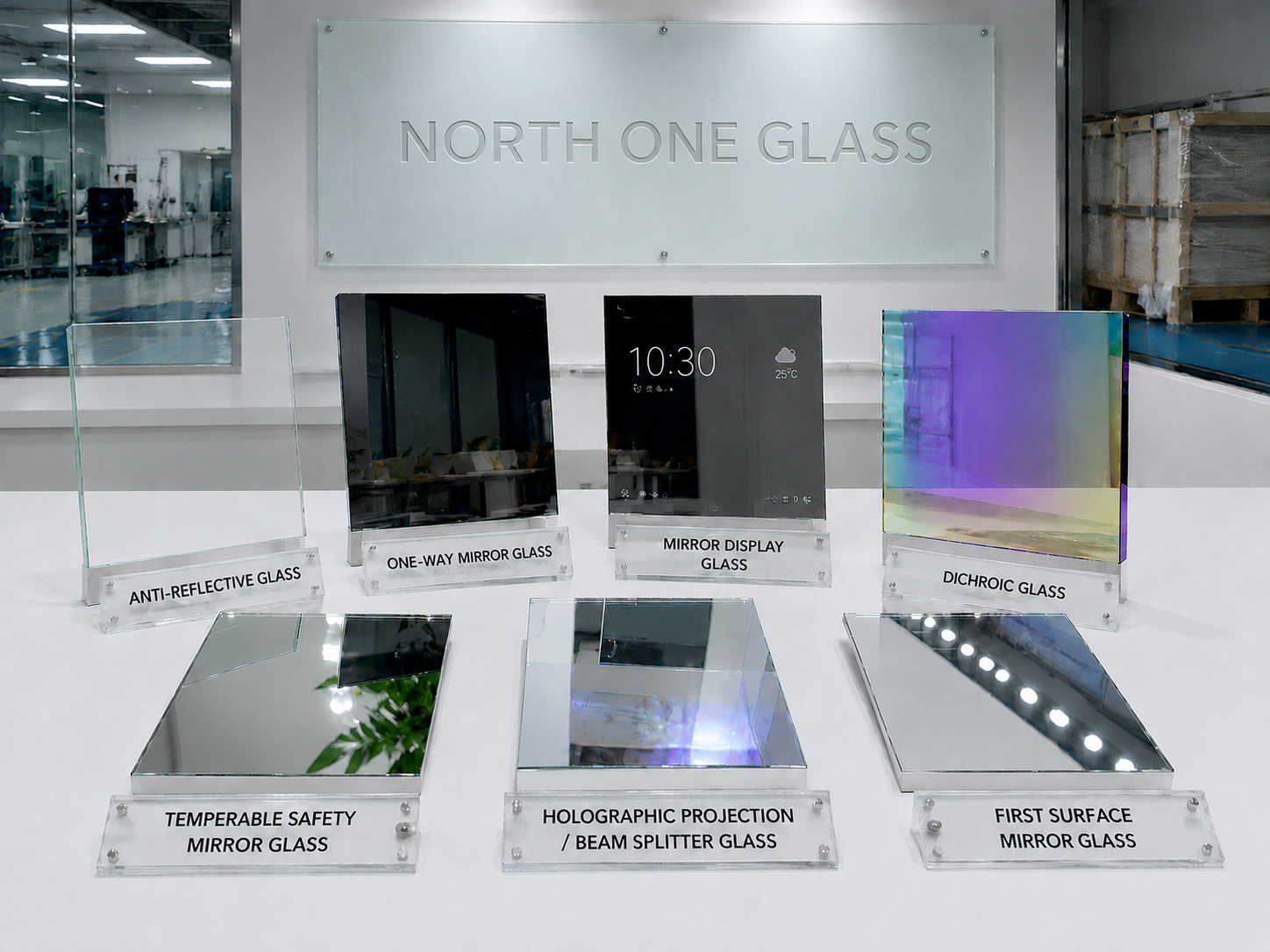
One-way mirror glass is often misunderstood. Some buyers expect it to work like a magic privacy wall in every room. In reality, the one-way effect comes from two things working together: a semi-reflective coated glass surface and a controlled lighting difference between the two sides. North One Glass supplies one-way mirror glass for observation rooms, privacy partitions, recording rooms, appliance panels, infinity mirror effects and project-based architectural use. The standard reference optical route is about 15% visible light transmission and 75% reflection, with custom transmission/reflection ratios available for project review. If the buyer understands the principle before ordering, it becomes much easier to choose the right thickness, installation direction, lighting plan and RFQ information.
One-Way Mirror and Two-Way Mirror Mean the Same Practical Idea
In the market, buyers may search for one-way mirror, two-way mirror, one-way glass, two-way glass, privacy mirror or observation room mirror. These terms usually refer to the same lighting-dependent principle: one side sees a mirror effect, while the other side can see through. The naming is not the most important part. The important part is the optical ratio, coating surface, room lighting and installation direction.
The Coating Principle
One-way mirror glass is not a normal mirror. A normal mirror is usually opaque because its reflective backing blocks vision through the glass. One-way mirror glass uses a semi-reflective coating. Part of the light is reflected, and part of the light passes through. North One Glass uses vacuum magnetron sputtering coating technology. The glass is cleaned with deionized pure water, dried, and then sent into a sputtering coating line. Nano-scale metal particles are deposited evenly on the glass surface, creating a controlled reflective and transmissive coating. This coating route is different from applying PET film to existing glass. Sputtered coated glass can be reviewed as a glass product for cutting, tempering, edgework, drilling, lamination or IGU construction depending on project requirements.
What VLT and Reflection Mean
Two key numbers help buyers understand one-way mirror glass:
North One Glass commonly uses a reference route around 15% VLT and 75% reflection. In simple terms, the glass reflects strongly enough to create a mirror effect on the bright side, while still allowing vision through from the darker side. Custom optical ratios can be reviewed, but the buyer should not choose a ratio only by looking at a number. The final effect depends on the real lighting, room layout, viewing distance, glass size, background color and installation condition.
- VLT, visible light transmission: how much visible light passes through the glass.
- Reflection: how much visible light is reflected from the coated surface.
Why the Bright Side Sees a Mirror
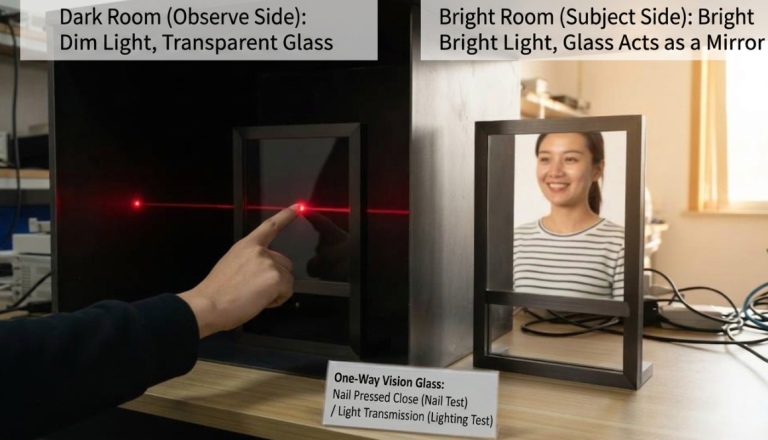
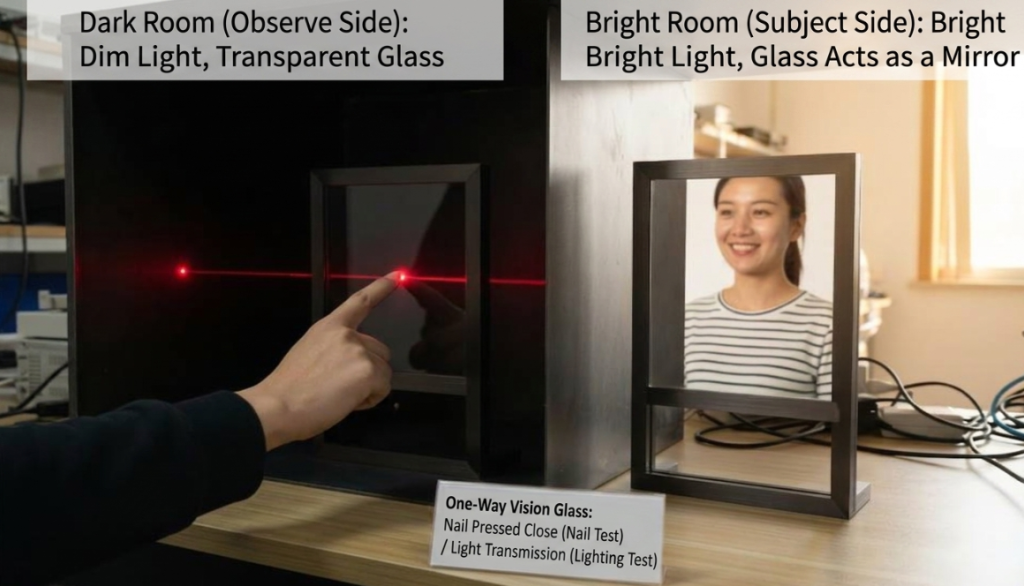
The brighter side sends more light toward the glass. Because the coating reflects much of that light, people on the bright side mainly see the reflection of their own room. Their eyes receive more reflected light than transmitted light from the darker side. That is why the observed room, interview room or public side should usually be brighter.
Why the Dark Side Can See Through
The darker side has less light reflecting back toward the viewer. People on this side receive more light coming from the bright side through the semi-reflective glass. This makes it possible to observe the brighter room. That is why the observation room should stay darker and should avoid bright lights near the glass.
The Lighting Ratio Rule
For one-way mirror glass, lighting is not a small detail. It is the operating condition. North One Glass recommends planning a bright-side to dark-side lighting ratio around 10:1 when privacy is important. If the project cannot reach 10:1, the ratio should not be lower than about 5:1 for practical privacy use. Examples:
- Good condition: interview room bright, observation room dark.
- Risk condition: both rooms have similar lighting.
- Failed condition: observation room light is on and bright at night.
- Reversed condition: outside is dark and inside is bright, making indoor privacy weaker.
What Happens at Night
At night, many privacy projects fail because the lighting reverses. During the day, an exterior side may be brighter, giving a mirror effect outside. At night, the interior may become brighter, and people outside may see in more easily. This does not mean the glass is defective. It means the lighting condition changed. For windows, facades and mirror-house projects, buyers should tell the factory whether the privacy effect is needed during the day, at night or both. Additional lighting design, curtains, interior layout or different glass construction may be needed.
Which Side Should Face the Bright Room
For observation and privacy applications, the reflective/coated side and the bright side must be reviewed before installation. North One Glass can provide direction labels according to the confirmed product route, but the buyer should still share the room layout and viewing direction before production. For example, an interrogation room, observation room or recording room should confirm:
- which side is the observed room;
- which side is the observation room;
- where the lights are installed;
- whether night use is required;
- where the viewer stands;
- whether the glass is single, laminated or installed in a frame.
Why Thickness Alone Does Not Create Privacy
Some buyers ask whether thicker glass gives better one-way privacy. Thickness may affect strength, safety, weight, processing and installation, but the one-way effect mainly depends on coating and lighting. A thick glass panel with poor lighting can perform worse than a thinner panel with correct lighting. Choose thickness by application:
- 1.1mm-3.2mm for electronics, appliance panels and smaller mirror effects.
- 4mm-10mm for partitions, wine cabinets, observation windows and decorative projects.
- 8mm-12mm laminated routes for higher safety observation or public-use projects.
- 12mm-15mm, laminated or IGU routes for outdoor mirror-house, facade or structural review.
Common Mistakes
Do not install one-way mirror glass without checking lighting. Similar brightness on both sides weakens the effect. Do not place strong lights behind the observation side. Reflections from the dark side can reveal the observer. Do not assume the effect is the same day and night. Exterior and interior brightness change. Do not compare one-way glass only by reflectivity. Too much reflection may reduce see-through performance. Do not order without confirming coating side, glass size, thickness, processing and installation route.
FAQ
Does one-way mirror glass work without a lighting difference?
No. The one-way effect needs one side to be much brighter than the other. If both sides have similar brightness, both sides may partially see reflection and transmission.
What lighting ratio is recommended?
A 10:1 bright-side to dark-side lighting ratio is recommended. For important privacy use, 5:1 should be treated as the minimum practical threshold.
Can the one-way effect reverse?
Yes. If the observation side becomes brighter than the observed side, the effect can weaken or reverse. This is common at night if interior lighting is brighter than exterior lighting.
Is one-way mirror glass the same as a normal mirror?
No. A normal mirror is not transparent. One-way mirror glass is semi-reflective, so it reflects part of the light and transmits part of the light.
Can the optical ratio be customized?
Custom transmission/reflection ratios can be reviewed according to application, lighting, viewing requirement and production feasibility.
What information should I send before ordering?
Send application, viewing direction, bright side, dark side, lighting condition, panel size, thickness, processing route, drawings and destination.