How Dichroic Glass Works: Optical Interference, Color Shift and Coating Quality
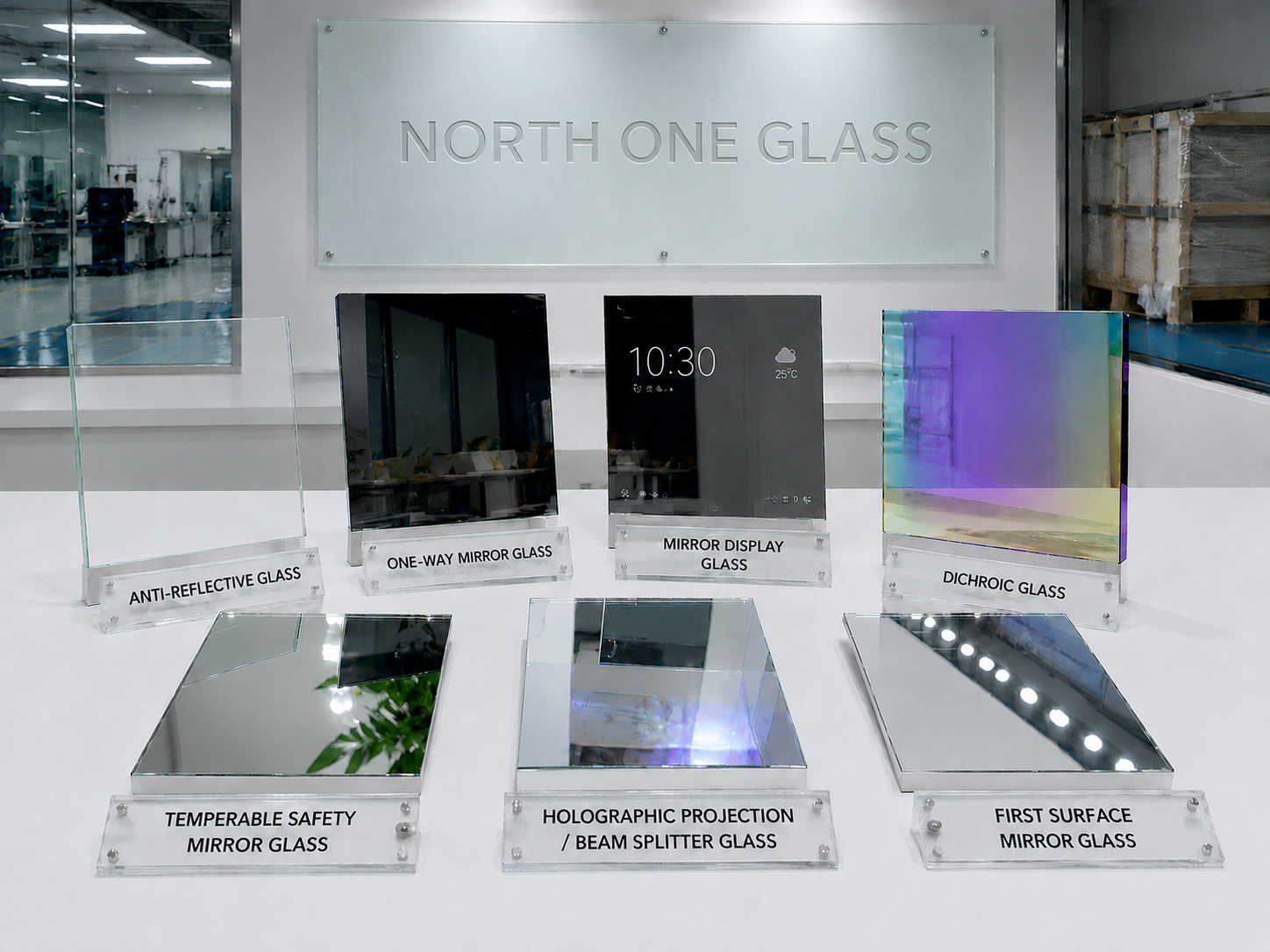
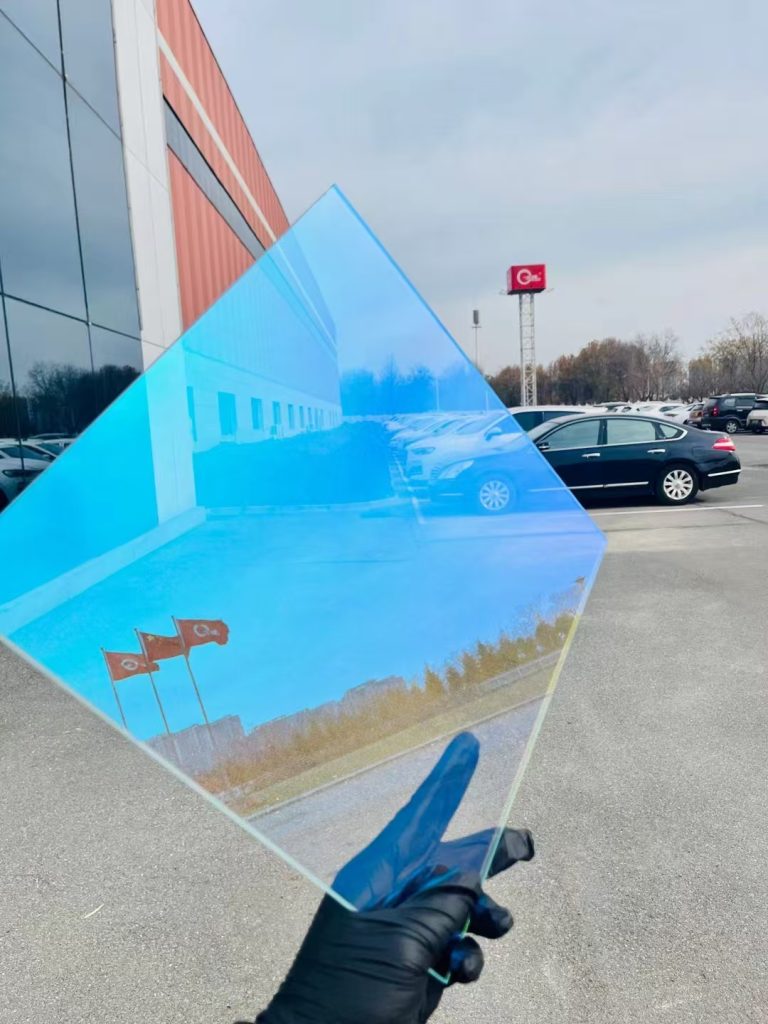
Dichroic glass, also called iridescent glass or color-shifting coated glass, creates different reflected and transmitted colors through optical interference. It is not ordinary tinted glass and it is not a rainbow PET film stuck onto clear glass. Multiple inorganic dielectric layers selectively strengthen certain visible wavelengths while allowing other wavelengths to pass through, producing a transparent color effect that changes with viewing angle and lighting.
The Optical Interference Principle
North One Glass deposits alternating high- and low-refractive-index dielectric layers onto selected float glass. Each layer is extremely thin. When light reaches the coating, some wavelengths reinforce each other in reflection while other wavelengths pass through the glass. This produces two related but different results:
| Observation | What the Viewer Sees |
|---|---|
| Looking at reflected light | A strong radiant color that shifts as the viewing angle changes |
| Looking through the glass | A complementary transmitted color with a more transparent appearance |
| Changing daylight or artificial light | Different intensity and color balance because the light spectrum has changed |
| Moving around a facade or object | A smooth gradient rather than one fixed painted color |
The effect is strongest when the project gives the glass room to interact with light. Across a typical 0°-60° observation range, the reflected and transmitted color can move through a visible gradient. A small sample viewed flat under office lighting may look very different from the same glass installed vertically near daylight.
How the Coating Is Produced
The substrate is cleaned with deionized water and automatically dried before entering a 16-metre-class vacuum magnetron sputtering coating line. Controlled dielectric oxide layers are deposited according to the selected color and spectral design. North One Glass supplies radiant orange, radiant blue and radiant green as standard color families. A customer sample or target spectrum can also be reviewed using spectral analysis and trial coating. Custom matching should be approved against a physical sample because photographs and screens cannot reproduce the full angle-dependent effect.
Technical Specification Matrix
| Parameter | North One Glass Dichroic Glass Capability | Reference in the Technical Brief |
|---|---|---|
| Substrate | Low-iron extra-clear or selected standard clear float glass | Optical performance may be reviewed with ISO 9050 / EN 410 methods |
| Thicknesses | 1.1mm, 2mm, 3mm, 4mm, 5mm, 6mm, 8mm, 10mm, 12mm and 15mm | Float-glass dimensional reference: EN 572-2 |
| Standard sheets | Nine stock-size routes from 915 x 1220mm to 3300 x 4880mm | Cutting-yield planning by finished-size drawing |
| Jumbo coating | Up to 3300 x 16000mm for project review | 16-metre-class coating-line capability |
| Scratch resistance | 5000 weighted steel-wool rubbing cycles without visible scratches or peeling | Industrial rubbing and adhesion review; GB/T 9286 may be used as a reference method |
| Outdoor durability | Confirmed 20-year outdoor performance statement | Salt-spray and corrosion review; ISO 9227 may be used as a reference method |
| Spectral measurement | PerkinElmer Lambda 950 UV-Vis-NIR spectrophotometer | Reflected and transmitted spectral analysis and sample matching |
The standards above describe reference test or measurement methods from the technical brief. They are not presented as certificates held by North One Glass; project-specific reports can be discussed when required.
Low-Iron Glass vs Standard Clear Glass
Low-iron glass reduces the natural green tone of ordinary float glass and usually gives a cleaner, brighter transmitted color. Standard clear glass can be more economical and may be appropriate when the project accepts a warmer or greener substrate influence. The buyer should compare both options when substrate cost and final color are equally important. The same coating recipe can look different on different substrates and thicknesses.
Why Color Changes With Angle
As the viewing angle changes, the optical path through the thin-film layers changes. The reinforced wavelength moves, so the viewer sees a different part of the color spectrum. This is the intended dichroic effect, not batch inconsistency. Batch inconsistency is different: two sheets viewed under the same light, from the same angle and against the same background should remain within the approved color tolerance. Buyers should define the viewing condition before rejecting or accepting a batch.
Tempering and Processing Stability
The inorganic coating route supports physical tempering at approximately 600-700°C, subject to the approved thickness, dimensions and processing route. The coating is designed to avoid deformation, peeling, fading, blistering and edge lifting during the approved cycle. Cutting, polished or beveled edging, drilling, notching, silk-screen printing, lamination and insulating-glass construction can also be reviewed. Holes and edgework should be completed before tempering.
Durability Tests That Matter
The approved product facts include 5000 weighted steel-wool rubbing cycles without visible scratches or peeling, resistance to acid, alkali and severe salt spray, and 20-year outdoor performance under wind, rain, strong UV, coastal salt exposure and humid conditions. These claims do not remove the need for correct installation. Edge sealing, drainage, compatible sealants, cleaning methods and structural support still affect the finished project.
How a Buyer Should Approve a Sample
View the sample from several angles in the real lighting environment. Compare reflected and transmitted color against a white, black and project-specific background. If the order will be tempered, approve a tempered sample rather than only a raw coated sheet. For batch approval, keep one signed reference sample. Record the substrate, thickness, color series, coating side, lighting condition and acceptable visual range. Spectral data can support the comparison, but it should not replace the architect or product designer's visual approval.
How to Judge a Manufacturer
A capable supplier should control substrate cleaning, coating deposition, color measurement, tempering compatibility and downstream processing. Ask whether the factory operates its own magnetron sputtering line, can measure reflected and transmitted spectra, can reproduce an approved sample and can process the final panel without sending the coating through several unrelated factories. North One Glass produces optical dichroic glass and supports spectral review, cutting-yield planning and processed panel delivery. For durability differences, see Dichroic Glass vs Dichroic Film.
Coated Dichroic Glass vs Metal-Colored Glass vs PET Film
Optical dichroic glass uses multilayer dielectric interference to create a transparent, high-saturation color shift. Traditional metal-colored coated glass normally produces a more fixed bronze, tea or metallic appearance. PET rainbow film can create a lower-cost decorative gradient, but it cannot pass through a glass tempering furnace and is more vulnerable to scratches, bubbles, adhesive failure and UV fading. The existing comparison article owns the full glass-versus-film decision. This technical distinction is included here because the manufacturing route directly affects what the buyer can process and where the material can be installed.
FAQ
Is dichroic glass the same as tinted glass?
No. Tinted glass mainly absorbs selected wavelengths and keeps a more fixed body color. Dichroic glass uses optical interference to reflect and transmit different wavelengths, creating a dynamic angle-dependent effect.
Can a photograph be used as the final color standard?
No. Camera settings, screens and lighting alter the appearance. Use a physical sample and define the viewing environment for final approval.
Does tempering change the dichroic color?
The approved North One Glass tempering route is designed to maintain the coating and color, but buyers should approve a tempered sample when color tolerance is critical.