Front Surface Mirror vs Second Surface Mirror: Differences, Cost and Selection Guide
A Front Surface Mirror reflects light from the optical coating on the front face of the glass. A second surface mirror, also called a rear-surface mirror, reflects light from a coating behind the glass. The front-surface route is selected when ghosting, secondary refraction and light loss would damage the optical result. The second-surface route is selected when coating protection, easier cleaning and lower optical precision are more important than maximum image accuracy.
Core Difference
| Decision Point | Front Surface Mirror | Second Surface Mirror |
|---|---|---|
| Coating position | Reflective coating is on the front surface | Reflective coating is behind the glass |
| Light path | Light reflects before passing through glass | Light passes through glass, reflects, then passes back through glass |
| Ghosting | Designed to remove secondary refraction and ghost image | Can create a second image or edge blur in critical optical paths |
| Visible light reflection | Visible light reflection reaches 95% | Depends on the rear coating, substrate and test conditions; request product-specific data |
| Coating protection | Coating is exposed and needs careful handling | Glass protects the reflective layer |
| Cleaning | Lint-free cloth or sterile cotton with IPA or deionized water, one-direction wiping | Often easier to clean because the coating is not exposed |
| Best fit | Projection, scanning, HUD, periscope and precision optical equipment | Decorative mirrors and non-critical reflection where ghosting is acceptable |
Cost and Procurement Tradeoff
A front surface mirror can cost more than a common rear-surface mirror because it needs a high-reflectance optical coating, substrate quality control, coating uniformity checks and careful packing. The final quote also depends on thickness, size, cutting yield, holes, edgework, inspection and export crate design. A second surface mirror may be cheaper and easier to protect, but the lower purchase price can be a false saving if ghosting reduces projector clarity, scanner accuracy or HUD image quality.
When to Choose a Front Surface Mirror
- The system cannot tolerate double images, secondary refraction or edge blur.
- The mirror is part of a projector light path, scanner assembly, optical turning system, wafer inspection unit or HUD image path.
- Brightness and light-energy utilization matter.
- Neutral reflected color and repeatable LAB appearance are important.
- The team can control handling, assembly and cleaning of the exposed coating.
When a Second Surface Mirror May Be Better
- The application is decorative or non-critical and small ghosting is acceptable.
- Users will touch or clean the mirror frequently.
- The mirror is installed where coating exposure cannot be controlled.
- The project does not have an optical accuracy requirement.
- The buyer needs the simplest low-risk replacement route.
Front Surface Mirror vs Film or Reflective Plastic
Reflective film or plastic may work for lightweight mock-ups, temporary setups or low-cost displays, but it should not be treated as an equal replacement for a precision optical mirror. The First Surface Mirror coating process uses vacuum magnetron reaction sputtering on selected float glass, with film thickness and uniformity controlled across the sheet. Buyers should test the actual reflected image, color, flatness and cleaning route before selecting a lower-cost substitute.
Sample Confirmation
For projectors, scanners, HUDs and semiconductor inspection systems, approve the mirror inside the real optical path or a close test fixture. Check ghosting, brightness, reflected color, edge accuracy, mounting stress and cleaning access. If the mirror will be cut or drilled, approve the finished sample, not only a raw sheet.
How North One Glass Supports Selection
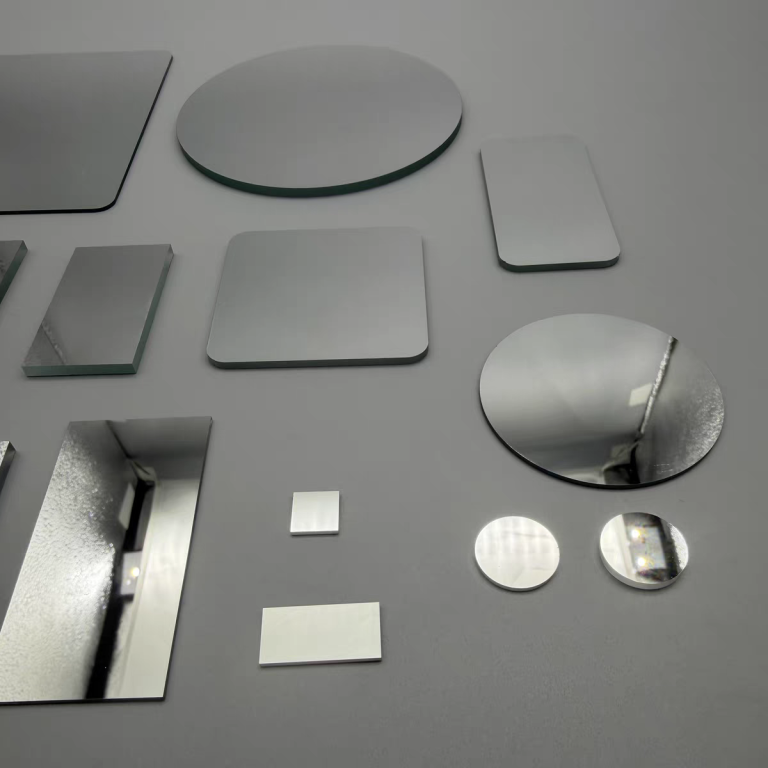
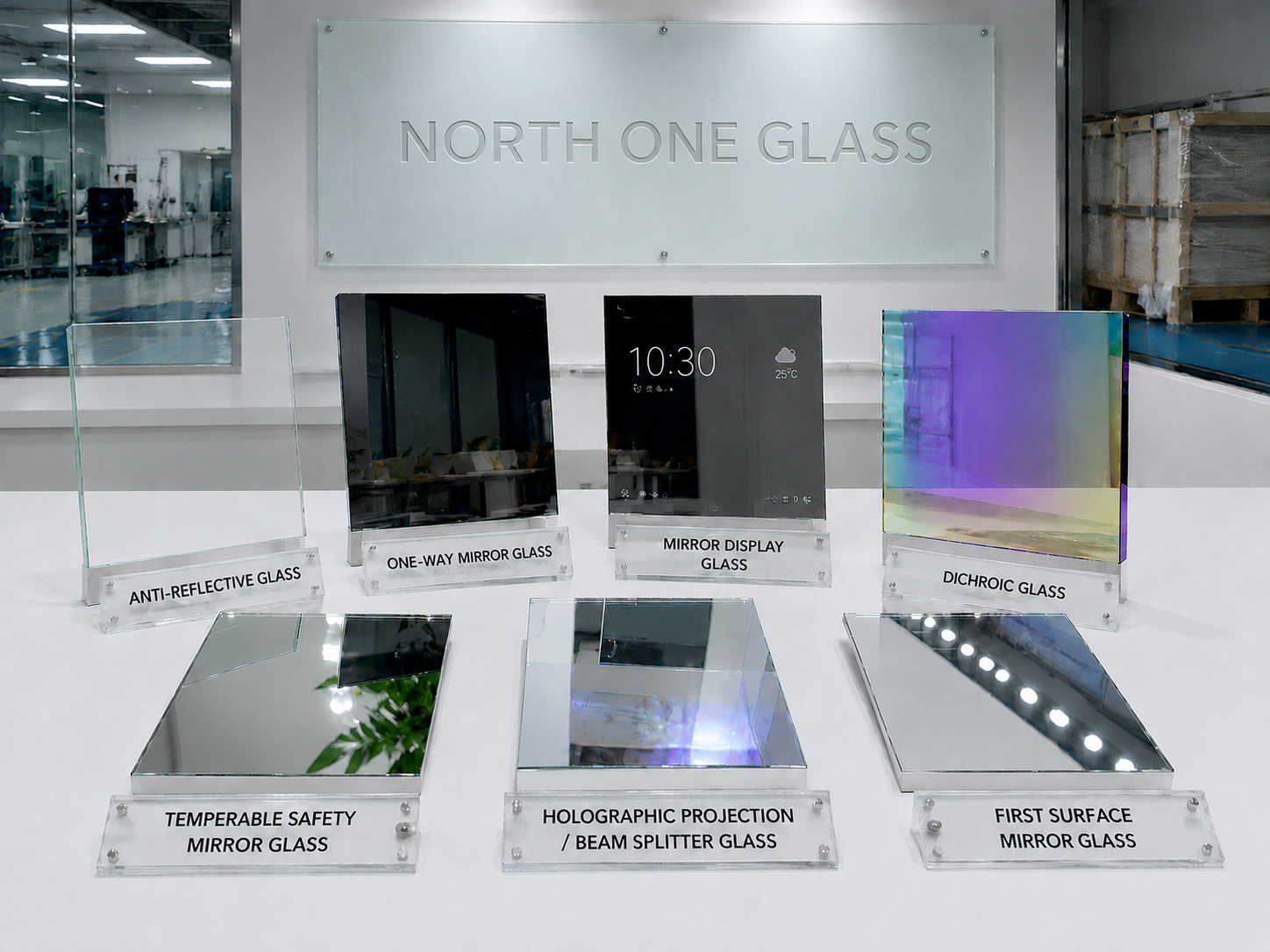
North One Glass supplies First Surface Mirror with 95% visible reflection, neutral LAB mirror color, hard optical coating, high adhesion and standard thicknesses from 1.1 mm to 15 mm. Processing can include custom cutting, shaped cutting, edging, drilling and drawing-based fabrication. The 95% First Surface Mirror product page gives the product specifications.
FAQ
Q: Is a Front Surface Mirror the same as a First Surface Mirror?
A: Yes. In this product family, both terms refer to a mirror with the reflective coating on the front surface.
Q: Why does a second surface mirror create ghosting?
A: Light first reflects weakly from the front glass surface, then reflects from the rear coating. These two paths can create a secondary image.
Q: Is a front surface mirror always better?
A: No. It is better for precision optical paths, but a second surface mirror may be more practical when coating protection and frequent cleaning matter more.
Q: Which mirror is better for projectors?
A: A front surface mirror is usually the correct starting point because projection systems are sensitive to ghosting, image blur and lumen loss.
Q: Which mirror is easier to clean?
A: A second surface mirror is generally easier because the coating is protected behind the glass. A front surface mirror must be cleaned gently on the coated face.
Q: Can a normal decorative mirror replace a first surface mirror?
A: Only in non-critical reflection uses. For scanners, HUDs, projectors or inspection equipment, test results usually decide the selection.
Q: What must be tested before choosing?
A: Test ghosting, reflection, color neutrality, flatness, mounting stress, cleaning access and the finished cut size in the real optical path.