


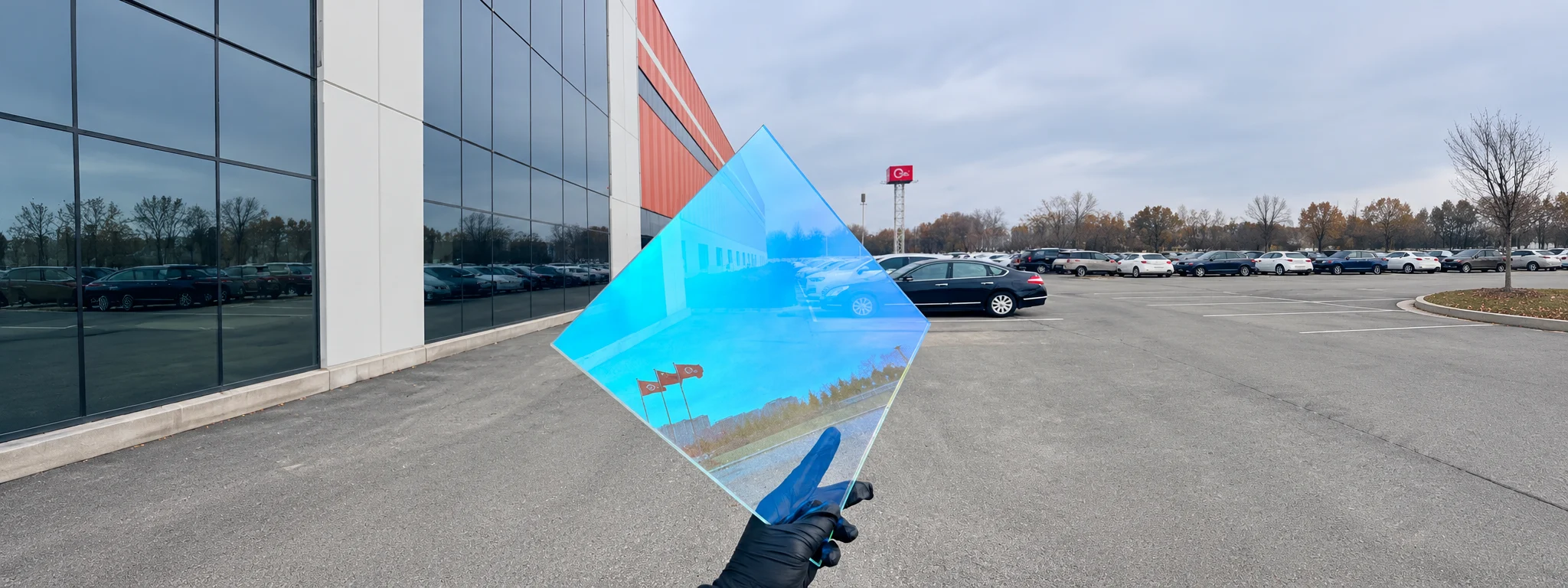
Dichroic Glass FAQ: Price, Colors, Tempering, Samples, MOQ, Packing and Outdoor Use
Dichroic glass combines a transparent architectural material with an angle-dependent optical color effect. International buyers should confirm the color under real lighting, substrate, thickness, finished sizes, processing, safety build-up, outdoor conditions and packing route before comparing prices. The following answers use North One Glass's confirmed production, commercial and project information.
Frequently Asked Questions
Q1: How should I evaluate a dichroic glass manufacturer in China?
We develop optical targets, evaluate samples, carry out precision glass processing in-house and deliver finished products worldwide. Detailed coating-stack design and coating manufacture use NorthGlass-operated equipment. Coating sizes up to 3,300 × 19,000 mm are available for eligible projects. Confirm the product, coating process, substrate, thickness, panel weight, handling, transport and delivery conditions. Finished cutting, edging, tempering and other downstream processes have separate limits.
Q2: What is the wholesale price of dichroic glass?
Bulk raw-sheet references are approximately USD 15/m² for 2-3.2mm, USD 20/m² for 5-8mm and USD 25/m² for 10-12mm FOB China Port. Tempered finished glass is approximately USD 30-50/m². Substrate, color target, dimensions, yield, processing, quantity and packing affect the final quotation.
Q3: Which processing services are available?
Supported routes include cutting, polished or beveled edging, drilling, notching, 600-700°C physical tempering, high-temperature silk-screen printing, PVB/SGP/EVA lamination and insulating-glass construction such as 5+12A+5. The drawing and glass build-up must be approved before production.
Q4: Will dichroic glass oxidize or develop black edges outdoors?
The approved inorganic coating route is resistant to acid, alkali, severe salt spray, strong UV and humid outdoor conditions. The product carries a confirmed 20-year outdoor performance statement against aging, peeling, fading, corrosion, oxidation and black-edge formation when the glass is correctly processed and installed.
Q5: How scratch-resistant is the coating?
The approved test uses 5000 weighted steel-wool rubbing cycles without visible scratches or peeling. Correct cleaning and sheet separation are still required because sand, metal tools and contact between glass sheets can damage any finished surface.
Q6: What is the maximum custom size?
Jumbo coating can be reviewed up to 3,300 × 19,000 mm. Common stock examples include 1830 x 2440mm, 2440 x 3660mm and 3300 x 4880mm. Final processed size depends on thickness, tempering, lamination, transport and lifting feasibility.
Q7: Can North One Glass match a customer's color sample?
Yes. A physical sample or spectral target can be analyzed with the PerkinElmer Lambda 950 UV-Vis-NIR spectrophotometer and reviewed for trial coating. The technical team can measure reflected and transmitted wavelength targets and prepare a matching sample. Final approval should still use a physical coated sample because reflected and transmitted color changes with lighting and viewing angle.
Q8: Are free samples available?
A standard A4 sample, approximately 210 x 297mm, can be supplied free. The buyer pays DHL, FedEx, UPS or equivalent international courier freight. Custom processed or specially matched samples may require separate review.
Q9: What is the MOQ and lead time?
Standard stock thicknesses and sizes support flexible MOQ and trial orders. Special thicknesses, custom colors or non-standard jumbo production generally require a standard 20-foot-container quantity or a production-plan agreement. Stock shipment preparation is generally 7-10 days after prepayment, while custom or large processed orders generally require 15-25 days.
Q10: How is dichroic glass packed for export?
Sheets use anti-mildew powder or moisture-resistant paper, reinforced fully enclosed fumigation-free wooden crates or A-frames, steel-band fixation and internal shock buffering. Mixed-size or jumbo orders require a crate and loading plan matched to repeated lifting, sea transport and site unloading. The commercial target is zero-breakage and zero-mildew delivery, supported by the agreed packing and receiving-inspection procedure.
Q11: Which standard colors and applications are available?
Standard families include radiant orange, radiant blue and radiant green. Thin 1.1-4mm routes suit appliance panels and framing, 4-8mm suits furniture and interiors, and 10-15mm or laminated/IGU routes suit landscape structures and facades.