Temperable Mirror FAQ: Selection, Installation, Cleaning and Troubleshooting
This FAQ is for B2B buyers, glass processors, contractors and designers comparing Temperable Mirror Glass with traditional mirror routes. It covers product definition, processing sequence, safety, prices, thicknesses, optical values, samples, reports, lead time, warranty, packing and troubleshooting.
Quick Data Table
| Buyer Question Area | Confirmed Temperable Mirror Reference |
|---|---|
| Raw sheet price | About USD 15/m² for 5-8 mm; about USD 20/m² for 10-12 mm |
| Tempered finished mirror price | About USD 20/m² for 3-6 mm; about USD 30/m² for 8-12 mm |
| Tempering fee | About USD 10-20/m², depending on thickness, size and processing |
| Standard optical range | T0-5/R70-75; common Tv about 1.4% and Rv about 70.5% |
| Thickness and size | 1.1-15 mm; jumbo capability up to 3300 x 16000 mm |
| Sample and lead time | Free standard sample with courier paid by buyer; ready-stock shipment 3-7 days; custom large/jumbo orders 15-25 days |
| Warranty and packing | 2-year raw sheet warranty, 20-year tempered finished outdoor black-edge/oxidation warranty, reinforced seaworthy crates |
FAQ
Q: What is Temperable Mirror Glass?
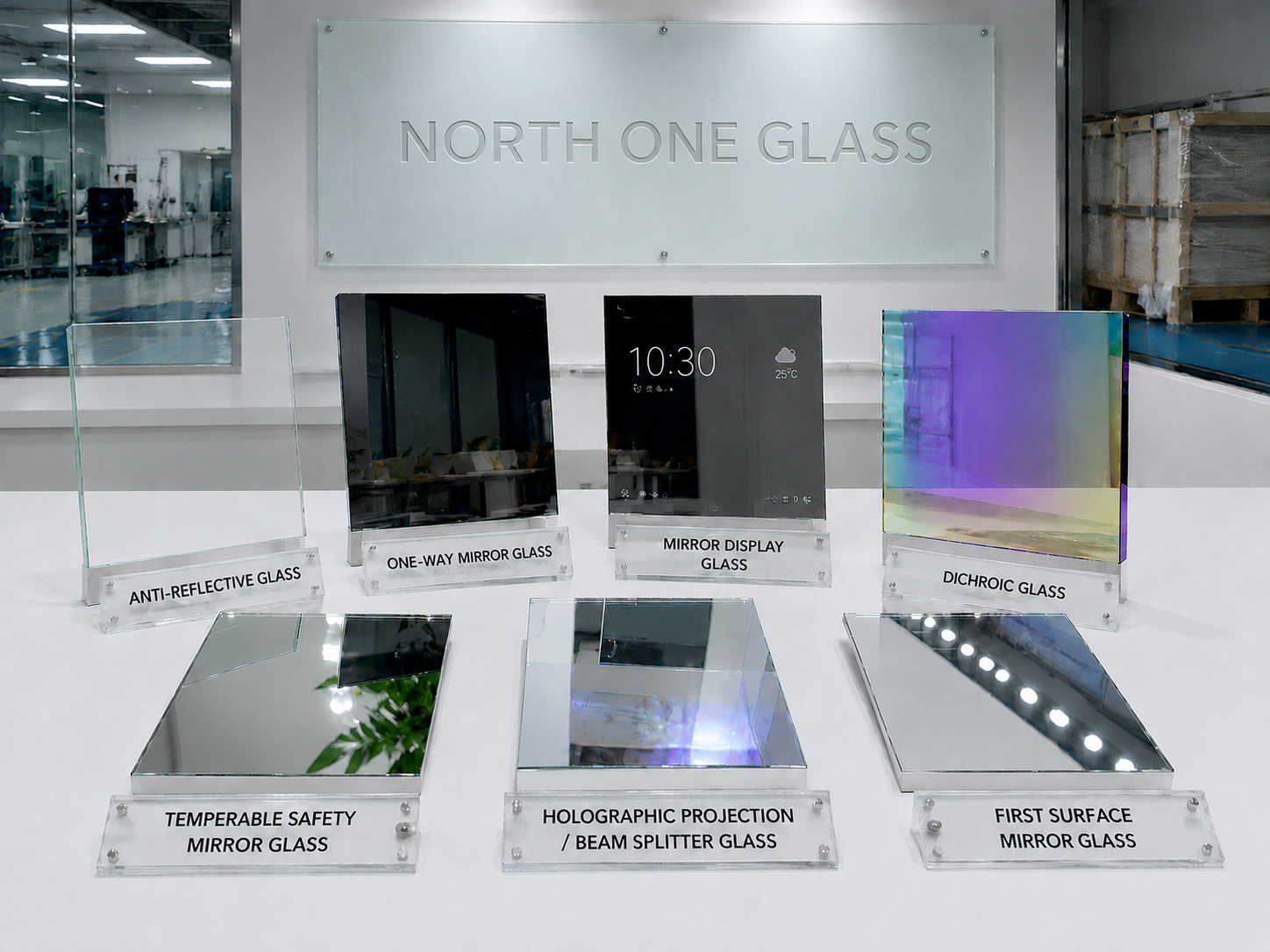
A: Temperable Mirror Glass is a vacuum-sputtered coated mirror that can be cut, edged, drilled and physically tempered after mirror coating.
Q: Is Temperable Mirror the same as Toughenable Mirror?
A: Yes. Toughenable Mirror is a supporting market term for the same temperable mirror route.
Q: How is it different from traditional silver mirror?
A: Traditional silver mirror uses silver or aluminum backing and paint, while Temperable Mirror uses a paint-free hard coating designed to survive physical tempering.
Q: Can it be cut before tempering?
A: Yes. Cutting, edge grinding, beveling, drilling, CNC shaping and other shape work should be completed before physical tempering.
Q: Can it be tempered after drilling?
A: Yes, holes and notches can be reviewed before tempering, but hole position, edge distance, size and furnace route must be checked.
Q: What is the standard optical range?
A: The standard range is T0-5/R70-75. The supplied text also gives common values around 1.4% visible transmission and 70.5% visible reflection.
Q: Can other reflection or transmission ratios be customized?
A: Yes. Other transmission and reflection combinations can be customized for one-way observation, mirror-TV facades, stage effects and other projects.
Q: What substrates are available?
A: Low-iron, clear, grey and bronze float glass can be used according to the project appearance and cost target.
Q: What thicknesses are available?
A: Available thicknesses include 1.1, 2, 3, 4, 5, 6, 8, 10, 12 and 15 mm.
Q: What is the maximum size?
A: The maximum custom size can reach 3300 x 16000 mm, subject to production, processing, packing and transport feasibility.
Q: How much do raw sheets cost?
A: Reference prices are about USD 15/m² for 5-8 mm raw sheets and about USD 20/m² for 10-12 mm raw sheets.
Q: How much do tempered finished mirrors cost?
A: Reference prices are about USD 20/m² for 3-6 mm tempered finished mirrors and about USD 30/m² for 8-12 mm tempered finished mirrors.
Q: How much is tempering?
A: The physical tempering fee is about USD 10-20/m², depending on thickness, size and processing complexity.
Q: Are samples available?
A: Yes. Standard samples are free, and the buyer pays courier freight.
Q: What can buyers test on samples?
A: Buyers can test cutting, edging, tempering, optical appearance, scratch resistance and acid/alkali immersion according to project needs.
Q: Are SGS and CNAS reports available?
A: The supplied text states SGS inspection and CNAS testing reports. Buyers should request the report matching the selected product and order.
Q: What warranty is offered?
A: The supplied text states 2 years for raw sheets and 20 years for tempered finished mirrors against outdoor black edge and oxidation.
Q: Can it be used outdoors?
A: Yes. It is positioned for wet, rainy, coastal, strong-UV, scenic-area and outdoor environments.
Q: Will the coating color change after tempering?
A: The supplied text states ΔE < 0.5 before and after tempering, with no visible color deviation.
Q: Will the coating peel during tempering?
A: The supplied text states no peeling, blistering, discoloration or edge chipping during the approved processing route.
Q: How is export packing handled?
A: Export packing uses heavy-duty fumigation-free seaworthy wooden crates, interleaving paper or anti-mildew powder, desiccant, cushioning and standardized container loading.
Q: What happens if glass breaks during ocean transit?
A: The supplied text states North One Glass takes liability and provides replacement or compensation for transport breakage; order terms should document the claim process.
Q: What is the lead time?
A: Ready-stock packing and shipment can be arranged in 3-7 days. Custom large orders or jumbo sizes generally require 15-25 days.
Q: What should I send for quotation?
A: Send substrate, thickness, optical target, raw or finished route, dimensions, quantity, drawings, processing, tempering, application, destination, sample/report needs and required schedule. For deeper reading, see the price guide, the comparison guide, the Temperable Mirror product family and the contact page.