


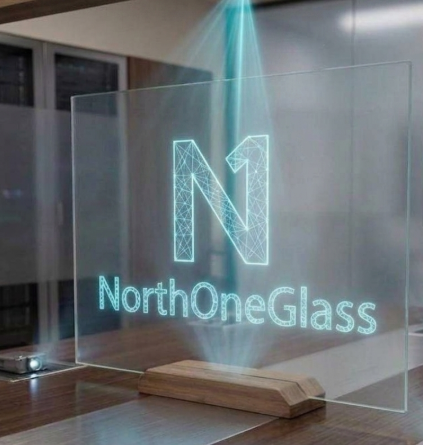
T70/R30 and T65/R35 describe two different transmission/reflection balances for beam-splitter glass. In simplified terms, T70/R30 prioritizes more see-through transmission, while T65/R35 redirects slightly more light toward the reflected image. The best choice depends on the whole optical system, not on which ratio sounds stronger.
TL;DR
- Start with T70/R30 when the direct view through the glass is especially important and the projected or reflected source has enough brightness.
- Consider T65/R35 when the reflected virtual image needs more optical share and a modest reduction in see-through transmission is acceptable.
- Validate both options at the actual incidence angle, wavelength range, source brightness, background, ambient light, and observer position.
What the glass does
The glass is a beam-splitting optical medium. It transmits part of the incoming light and reflects another part to form or redirect an image in a HUD, exhibition, teleprompter, stage, imaging, or similar optical arrangement. It is not a complete holographic projector and does not generate content by itself. The system still needs a source, optical path, mechanical alignment, image geometry, and controlled environment. Headline T/R values are useful for initial selection but do not fully describe system performance. Ask how the values are measured and define the wavelength, angle of incidence, polarization if relevant, coating side, substrate, and acceptance tolerance. Visual contrast also depends on background luminance, stray light, source black level, and enclosure design.
Prototype decision checklist
The Holographic Projection Glass category explains the product family. Review the T70/R30 HUD and exhibition product as a starting reference, then compare it with a project-specific T65/R35 sample. Related optical products are available in the products hub.
- Define whether the transmitted scene or reflected image has priority.
- Record source type, brightness, color range, image size, and optical path.
- State the working angle and observer eye box or viewing zone.
- Describe ambient lighting and background brightness.
- Provide glass size, substrate, thickness, shape, edgework, holes, flatness, and mounting needs.
- Agree on T/R test conditions, color, ghost-image limits, distortion, and approved sample.
FAQ
Is T65/R35 always brighter than T70/R30?
It allocates a larger nominal share to reflection, but perceived image brightness and contrast still depend on measurement conditions, source output, angle, background, losses, and the complete optical path.
Does this glass create a hologram by itself?
No. It is a beam-splitting component used inside a projection or virtual-image system. It does not supply the image source, software, alignment, or enclosure.
What is needed before ordering a prototype?
Send the optical layout, working angle, source and brightness, viewing zone, required T/R test conditions, glass drawing, processing, quantity, and destination through the contact page.