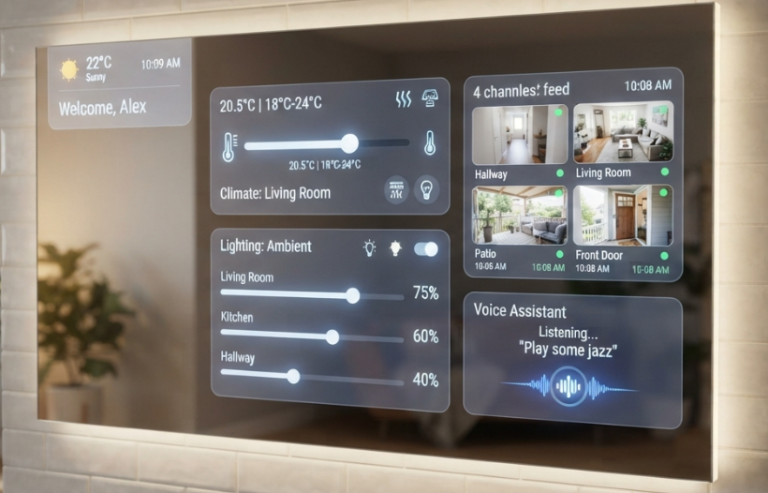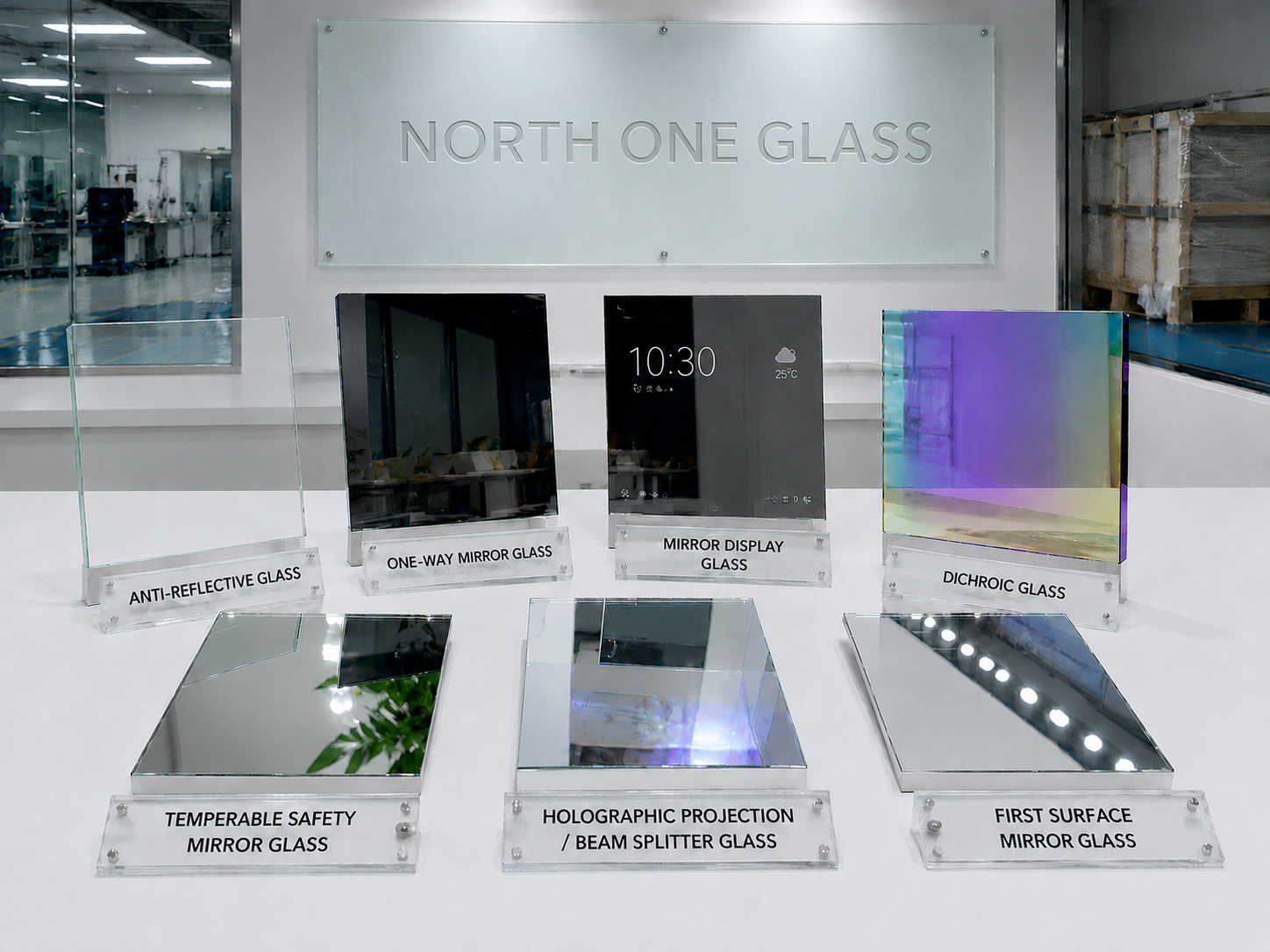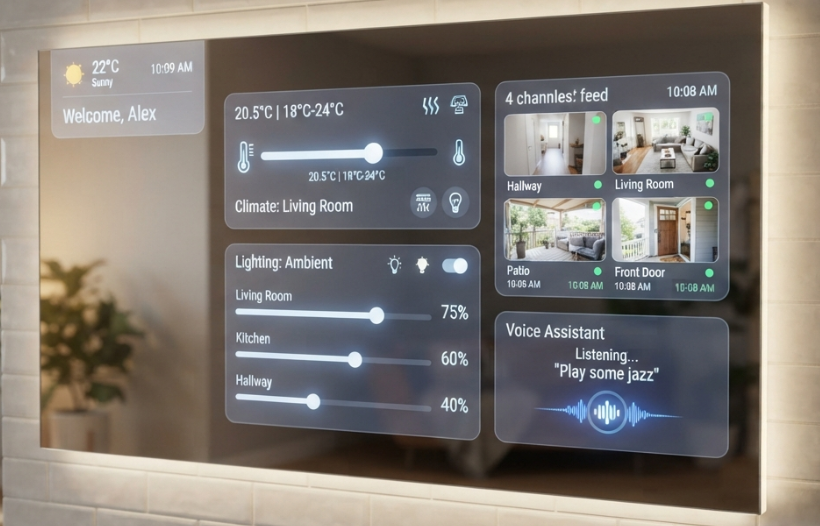
Mirror display glass and one-way mirror glass both balance reflection and transmission, but they are normally optimized for different systems. Mirror display glass is selected to hide a screen behind a mirror-like surface while allowing the illuminated image to remain readable. One-way mirror glass is selected around a bright-side/dark-side observation or privacy arrangement.
TL;DR
- Choose mirror display glass for smart mirrors, concealed digital signage, retail displays, fitness mirrors, and interfaces where an active screen must be visible through a reflective front.
- Choose one-way mirror glass for observation, monitoring, privacy, or theatrical effects controlled by lighting on two sides.
- Do not choose from the reflection number alone. Screen brightness, black level, color shift, ambient light, viewing angle, air gap, and lighting ratio affect the result.
Different system goals
In a mirror display, the dark area of the screen should visually merge with the mirror surface while bright pixels transmit through the glass. The design must balance mirror appearance when the screen is off with image brightness and color when it is on. A higher reflection is not automatically better if it makes the display too dim. In an observation installation, the goal is different: the brighter room should mainly see its reflection while the darker room observes through the panel. The lighting ratio between rooms is a core design input. This material is not switchable privacy glass and does not electronically change state.
Compare in the real assembly
For a mirror display sample, use the intended panel, screen, brightness setting, background, air gap, bezel treatment, and room lighting. For one-way observation glass, reproduce the two-room light levels, sightlines, wall colors, and observer position. A sample viewed alone cannot confirm either system. Define these items in the enquiry:
Review the Mirror Display Glass category and T30/R70 mirror display product for screen-based projects. For observation projects, use the One-Way Mirror Glass category.
- application and desired mirror/display or observation behavior;
- target transmission, reflection, and color requirements;
- screen type and brightness, or lighting levels on both sides;
- panel size, substrate, thickness, edgework, holes, and shape;
- coating orientation, assembly, bonding, lamination, or insulating-glass needs;
- acceptance sample, test method, quantity, and destination.
FAQ
Can one-way mirror glass be used in front of a display?
It may produce a visible image in some assemblies, but a mirror display should be selected and tested for screen brightness, black level, color, ambient light, and mirror appearance rather than assumed from an observation-grade product.
Is mirror display glass switchable smart glass?
No. It is a partially reflective and partially transmissive optical glass. The image changes because the screen behind it turns on or off, not because the glass switches state.
What should I send for sample selection?
Send the application, screen and brightness or room-lighting data, panel drawing, optical targets, coating orientation, processing, quantity, and destination through the contact page.